

Have you ever read something that made you stop and think,
Wait… is this why I talk/behave/ communicate this way?
I always say that you know a book is truly good when you go in looking for a good read and come out questioning everything.
For example, I used to think I had a solid understanding of who I was. I thought I knew the motivations behind my choices. Then I picked up "The Courage to Be Disliked", expecting a casual self-help read, and instead got forced to confront the fact that a lot of what I thought defined me, wasn't really me at all.
Books have a way of getting under your skin like that. Maybe you're not as independent as you thought. Maybe your "laid-back" attitude is just avoidance. Maybe the way you see yourself is completely off.
So if you think you know yourself pretty well, I have some books for you that might just prove you wrong and force you to reconsider a lot of things.
Will it be uncomfortable? Yes. But in the long run, that kind of discomfort — that kind of reflection — is exactly what you need to grow, evolve, and break free from your mental and emotional ruts.
"Strangers to Ourselves" by Rachel Aviv
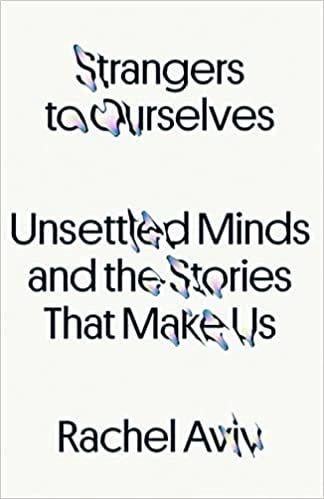
How much of your identity is truly yours, and how much of it has been shaped by what others have told you?
That's the question this book forces you to ask.
It tells real-life stories of people diagnosed with mental illnesses — people who were given a label, a narrative, and an explanation for their struggles. And here's the plot twist: those explanations weren't entirely accurate.
What if the way we understand ourselves is influenced by the words, opinions, and expectations of others more than we realize?
This one hit me hard because, as someone who reads and thinks deeply about self-awareness, I like to believe I know myself. And the book truly challenged me by making me reflect on whether I had truly shaped my own identity, or I had just pieced it together based on what my family, teachers, and friends had been saying about me throughout the years.
Labels can be helpful, but they can also cause a lot of harm.
Science backs this up. Studies in psychology show that self-perception is heavily influenced by social labeling theory — the idea that once we're given a label (whether it's "introvert," "lazy," "bad at math", "good with jokes"), we subconsciously start to embody it. We internalize the label and act accordingly.
Reading this book will make you rethink how much of your personality and behavior is actually yours versus how much you've absorbed from outside influences.
Are you really who you think you are, or are you just playing a role you were assigned?
"Culture shapes the scripts that expressions of distress will follow."
"It's startling to realize how narrowly we avoid, or miss, living radically different lives."
"Mental illnesses are often seen as chronic and intractable forces that take over our lives, but I wonder how much the stories we tell about them, especially in the beginning, can shape their course. People can feel freed by these stories, but they can also get stuck in them."
"The Denial of Death" by Ernest Becker
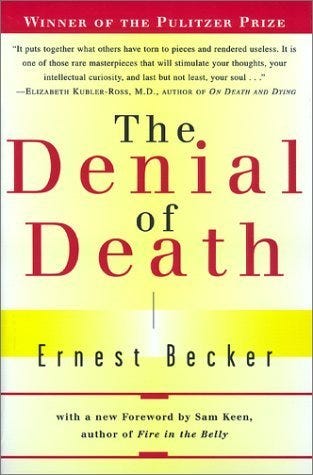
Where to even start with this book?
Full disclosure: it will probably make you feel uncomfortable. It takes a hard, almost brutal look at the things we do to give our lives meaning, and the extent to which we might deny our true existential reality.
In simpler words, it argues that much of our lives is driven by our fear of death. Deep down, we all have an unconscious fear of death that drives much of our behavior, and the ways we cope with it are often so ingrained that we don't even realize we're doing it.
There's a psychology theory called "Terror Management Theory", which suggests that when faced with reminders of mortality, humans subconsciously engage in behaviors that provide a sense of meaning or permanence. So our values, material pursuits, prejudices, and even our relationships are often shaped by this unconscious fear of death.
You think you're striving for success because you're ambitious? Think again. You think you want more power, or maybe more love? Maybe what you're trying to avoid is that we're all just here temporarily.
"Guilt results from unused life, from the unlived in us."
I know, it's a bit dark and gloomy — not an easy reality to swallow — but it's exactly what we need if we're ever going to truly understand ourselves and our motivations.
The book challenges the comforting myths we tell ourselves about living a life of meaning. You may think you're living authentically, but the book suggests that without confronting the truth of death, you're just hiding from it. It's not until you're able to face the reality of your impermanence that you can truly start living in a way that reflects what you actually want.
"It is fateful and ironic how the lie we need in order to live dooms us to a life that is never really ours."
"Obviously, all religions fall far short of their own ideals."
"Take stock of those around you and you will … hear them talk in precise terms about themselves and their surroundings, which would seem to point to them having ideas on the matter. But start to analyse those ideas and you will find that they hardly reflect in any way the reality to which they appear to refer, and if you go deeper you will discover that there is not even an attempt to adjust the ideas to this reality."
"The Body Keeps the Score" by Bessel van der Kolk
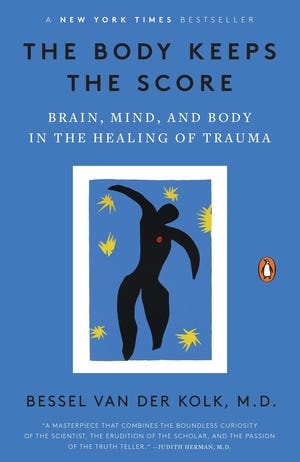
If you've ever reacted to something that felt way bigger than the situation called for and thought, what the actual f*ck, this book will give you some interesting answers.
We like to think of trauma as something that only affects people with extreme pasts, but this book proves that's not true.
Trauma isn't just something that exists in your mind — it lives in your body, too. Memories, stress, and emotional wounds don't just disappear; they get stored in your nervous system, shaping your responses long after the actual event is over.
In my own experience, reading the book was eye-opening because it connected the dots between my own patterns of stress and past experiences I had never fully acknowledged.
It's interesting — and quite unsettling — to think that even when we believe we've "moved on" from something, the body might still be holding onto those experiences in ways we can't always see.
If someone makes a comment, and your heart starts racing, or a harmless argument leaves you feeling shaken for hours, that's trauma speaking. Your body remembers things even when your mind tries to move on, and you can't claim you know yourself if you're not aware of how past trauma is affecting the current you.
The book explains why these things happen — and, more importantly, what you can do about them. It will make you rethink how much control you actually have over your emotions and reactions and how much baggage from the past your body keeps holding onto.
"As long as you keep secrets and suppress information, you are fundamentally at war with yourself…The critical issue is allowing yourself to know what you know. That takes an enormous amount of courage."
"Trauma causes people to remain stuck in interpreting the present in light of an unchanging past. The scene you re-create in a structure may or may not be precisely what happened, but it represents the structure of your inner world: your internal map and the hidden rules that you have been living by."
"The Road to Character" by David Brooks
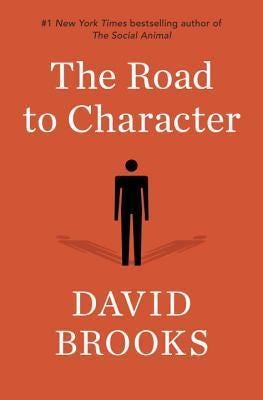
Let me ask you something.
What would you want people to say about you at the end of your life?
Would you want them to talk about your achievements? Your skills? Your career? Or your kindness? Your empathy? Your integrity?
If you're honest, are you sure you're prioritizing the right things?
Enter this book. It examines how we form our character in an age where achievements define us in the eyes of society and explores the lives of various historical figures, contrasting those who achieved external success with those who lived by a stronger moral code.
For me, this book was a slap in the face, because I was raised in an environment where achievement in my career and climbing the social ladder were the ultimate markers of worth. But success on paper doesn't mean a thing if it doesn't align with the kind of person you want to become.
In our current world, shifting your mindset can feel like swimming against the current. But the book made me realize that it's worth it. It's worth aiming for a life with depth and integrity, rather than just one with achievements.
It's easy to mistake success for character.
If you think you already know what truly matters, if you think you've already got a handle on what it means to live a meaningful life, this book will make you reconsider it all.
"Humility is the awareness that there's a lot you don't know and that a lot of what you think you know is distorted or wrong."
"You have to give to receive. You have to surrender to something outside yourself to gain strength within yourself. You have to conquer your desire to get what you crave. Success leads to the greatest failure, which is pride. Failure leads to the greatest success, which is humility and learning. In order to fulfill yourself, you have to forget yourself. In order to find yourself, you have to lose yourself."
In the end, if you think you know yourself, these books will probably surprise you.
If you're ready to face some uncomfortable truths and transform how you see yourself, they are the perfect starting point.
Honestly? Your future self will thank you.
Thank you for reading! If you liked these book recommendations, consider subscribing to my free book newsletter!