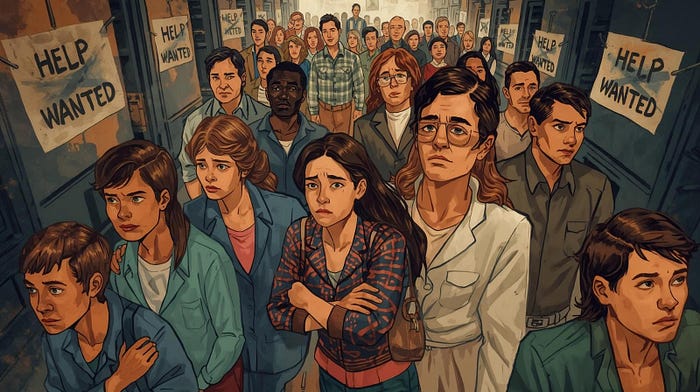

Job Market
I'm 57 and tired. Tired of sending out applications and hearing nothing. I watch younger people with better resumes do the same thing. We're all getting crushed by the same machine, just from different angles.
The market has fractured into something brutal. It's like some twisted monster from Stranger Things, but worse.
Companies don't want me because I'm too expensive and supposedly can't learn new tools. They don't want 23-year-olds because training takes time and AI can do their job faster. They want people in their early 30s who already know everything, cost less than I do, and can start contributing yesterday.
Even then, those people aren't managing teams anymore. They're managing AI.
This isn't a generational war. It's a structural collapse. And most of us are trapped in it.
The Entry-Level Apocalypse
Entry-level job postings plummeted 29 percentage points since January 2024. That's not a slowdown. That's a cliff.
My son is autistic. I'm back in the Philippines with my family now, but I'm no closer to finding stable work than I was when I was in Tucson. I think about what kind of world he's going to enter when he's old enough to work. And the answer terrifies me.
Entry-level roles saw an average decrease in hiring rates of 73.4% compared to just a 7.4% decrease across all job levels. Companies are using AI to eliminate the bottom rung entirely. In tech, entry-level postings dropped 60% between 2022 and 2024, with Google and Meta hiring around 50% fewer new grads compared to 2021, and Salesforce announcing it would halt junior hiring for 2025.
A computer science professor at UC Berkeley explained the thinking: "Why hire an undergraduate when AI is cheaper and quicker?" The AI code isn't perfect. Neither is code from new graduates. But improving AI code takes minutes. Training a junior developer takes months.
In San Francisco, more than 80% of "entry-level" jobs now require at least two years of experience. That's not entry-level. That's experienced workers at entry-level pay.
The kids graduating college right now are facing something I never did. I got my first freelance gigs in my 30s because someone took a chance on me. Nobody's taking chances anymore.
The Older Worker Trap
I've been freelancing for over 20 years. I've built websites, written thousands of articles, designed brands from scratch. I know my tools. I use AI every day. I'm faster now than I was at 30.
None of it matters.
In 2024, the EEOC received 16,223 charges of age discrimination, an increase from 14,144 in 2023 and 11,500 in 2022. 74% of older job seekers believe their age will be considered a barrier to a hiring manager, including 42% who see it as a major barrier.
The data confirms what we already know. When employers knew applicants' ages from the start, those over 40 were far less likely to be called for interviews, resulting in younger applicants being 68% more likely to be hired.
I've had heart attacks. I've had breakdowns. I've been broke more times than I can count. But I keep showing up. I keep learning. I keep building.
And companies still see my resume and think, "He's too old. He'll want too much money. He won't learn fast enough. He'll retire in 10 years."
The system doesn't want to invest in you when you have 10 or 15 years left. It wants someone with 30 years of runway who will accept less and work longer hours without complaining.
The Middle is Disappearing
Prime-age labor force participation for workers aged 25–54 stood at 83.4% in May 2025. These are the people companies want. Late 20s through early 40s. Experienced but not expensive.
But even they're not safe.
Fiverr laid off 250 workers, about 30% of its workforce, to adhere to an 'AI-First' mindset, with its CEO believing this would lead to substantially greater productivity and far fewer management layers. Senior leadership roles barely declined while the overall job market contracted 8%, with machine learning engineers seeing postings surge 40% from 2024 to 2025.
A VP of Product who can spin up a working prototype in Cursor or validate a technical approach with Claude doesn't need as many individual contributors reporting to them. Companies want strategists. They want people who can orchestrate AI systems. They don't want middle managers or junior developers or anyone who can be replaced by a prompt.
The career ladder is broken. You can't climb from junior to senior because there are no junior positions. You can't age into consulting roles because no one wants to pay for experience. You're stuck between a generation that can't get hired and a generation that's being pushed out.
AI is Eating Everything
Three in 10 companies replaced workers with AI in 2024, and 38% of companies that will use AI in 2025 will replace workers with the technology next year. Many boards of directors are now pushing CEOs to cut 20% of workforce costs, with the expectation that AI will take over the eliminated jobs.
I use AI every day. Claude helps me think faster. Perplexity helps me research better (all this research came from perplexity). But I'm not naive about what's happening. AI isn't just replacing tasks. It's replacing people.
Companies prefer to automate repetitive tasks and have them done quickly and cheaply by AI, rather than hire and train junior employees who will also take more time and make more human errors at such tasks. Since 2021, the average age of technical hires has increased by three years as companies become unwilling to invest in training junior talent.
The jobs that used to be training grounds are gone. The jobs that used to reward decades of experience are gone. What's left is a narrow band in the middle where you have to be good enough to not need training but cheap enough to not cost too much.
And that band keeps getting narrower.
We're All Getting Squeezed
This isn't about boomers vs. millennials vs. Gen Z. This is about a system that has decided most of us are disposable.
If you're over 40, they think you cost too much and can't adapt. If you're under 30, they think you need too much training and AI can do your job. If you're in your 30s, you're fighting for shrinking positions against people exactly like you.
I'm back with my family in the Philippines now. That's the win. But I'm still sending out applications. Still pitching clients. Still no closer to landing something stable than I was months ago.
My son is autistic. My daughter is a teenager. My wife and I are taking care of them while I try to figure out how to make this work. I'm 57, and the market has decided I'm obsolete.
And I look at the 22-year-olds sending out hundreds of applications and getting ghosted, and I realize we're in the same fight. Different reasons. Same outcome.
The rules changed while we weren't looking. Companies stopped investing in people. They stopped believing in growth. They started believing in efficiency and AI and cutting costs at all costs.
Now we're all scrambling to survive in a market that doesn't want us anymore.
I don't have answers. I'm in the same fight you are. Sending out applications. Pitching clients. Trying to prove I'm worth hiring when the system has already decided I'm not.
What I know is this: we're not lazy. We're not obsolete. We're not asking for too much.
The system is just broken. And it's broken for all of us.