
Explore how Agentic AI is poised to reshape industries, driving strategic transformation, measurable gains, and lasting competitive edge — if leaders embrace change.

In the first part of this 5 part series, I started discussing Model Context Protocol: Bridging AI and Enterprise Reality — In this second part, we spoke about Crew AI & Semantic Kernel Orchestrating Collaborative Intelligence, and in the 3rd part we spoke about LangChain & LangGraph: Building Dynamic Agentic Workflows. In the fourth part of this series, we discussed Agentic AI frameworks like Manus, and AutoGen.
In this 5th and final part, we will review the compelling ROI of agentic AI across industries, highlighting millions in cost savings — like UPS's $300M annual logistics reduction — and revenue gains, such as banking's $34M boost from enhanced client acquisition. We'll underscore strategic benefits beyond numbers, including workforce focus on high-value tasks and global adoption trends, tempered by challenges like data security and change management. Key takeaways will emphasize prioritizing quick-win use cases to drive measurable returns and long-term transformation. I would start by saying that:
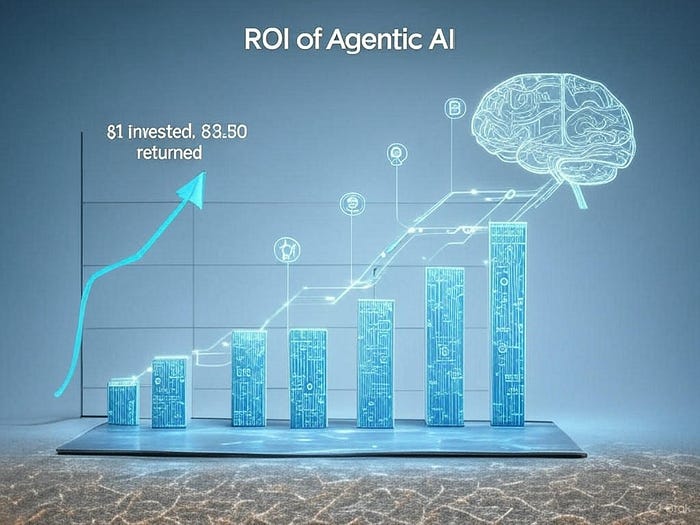
For business leaders navigating this tech-driven landscape, the data from agentic AI deployments — like UPS quietly trimming $300M in logistics costs or banks adding $34M to the topline — hints at a shift too potent to ignore, with $3.50 returned per $1 invested and breakeven in 14 months. While 42% of peers report OPEX savings and 59% see revenue upticks, the prudent move isn't clinging to legacy playbooks. It's about measured risk — recalibrating capex forecasts, eyeing NPV upside, and leaning into use cases with clear EBITDA lift.
In a world where lagging erodes margins subtly but surely, the smart money tilts toward AI's potential, not away from it.
The Business Case for Agentic AI
Agentic AI, capable of autonomously performing tasks with minimal oversight, offers business leaders a compelling value proposition: significant cost savings, productivity boosts, and revenue growth, with studies showing an average return of $3.50 for every $1 invested and payback within 14 months. Over 42% of companies report reduced costs and 59% see revenue increases from AI, yet pragmatism prevails — half of CFOs plan to cut investments if ROI isn't proven within a year. This section explores the tangible ROI of agentic AI across finance, healthcare, and manufacturing, providing real-world examples and strategic insights from a global perspective.
For business leaders, the promise of Agentic AI lies in tangible business value — cost savings, productivity gains, and revenue growth — balanced against investment and risk.
Recent studies indicate that this value is real: organizations are seeing an average of $3.50 in returns for every $1 invested in AI, with payback in about 14 months (Quantifying the Opportunity Value of Agentic AI). Over 42% of companies report cost reductions and 59% report revenue increases from AI initiatives, according to McKinsey (ROI and Business Value of Agentic AI). However, business leaders are also pragmatic. In one survey, 50% of CFOs said they will cut AI investments if no measurable ROI is realized within a year (The AI Tipping Point: Half of CFOs will axe AI investment if it doesn't show ROI next year). This urgency to demonstrate ROI is driving a focus on high-impact use cases. The following sections explore real-world ROI examples of agentic AI across finance, healthcare, and manufacturing — highlighting quantitative metrics and strategic transformations — from a global perspective.
Agentic AI in Finance
Agentic AI is transforming financial services and internal finance processes by automating routine work, enhancing decision-making, and uncovering new revenue opportunities. Key ROI examples in finance include:
- Enhanced Revenue Generation: A leading bank used an AI agent to support its business development officers, automating tasks like pipeline tracking and document processing. By freeing ~15% of their time, each officer was able to hold 25% more client meetings, resulting in ~25% more new business. For one regional bank, this meant an additional $0.34M in revenue per officer — or ~$34M annually with 100 officers (Quantifying the Opportunity Value of Agentic AI). In effect, agentic AI allowed the bank to scale revenue without proportional headcount growth, directly boosting top-line performance.
- Operational Efficiency & Cost Savings: business leaders are applying AI agents in finance operations (e.g. accounting, payables) to reduce manual workload and errors. For example, automating the accounts payable process with AI can yield 136% ROI over three years, saving $1.36 million for every $1 million invested (The AI Tipping Point: Half of CFOs will axe AI investment if it doesn't show ROI next year). These savings come from lower processing costs, fewer errors, and faster cycle times. At JPMorgan Chase, a proprietary generative AI assistant ("LLM Suite") was rolled out to 60,000 employees to streamline tasks like email drafting and reporting (Quantifying the Opportunity Value of Agentic AI) — a massive productivity play that underscores the scale of efficiency gains possible. Industry surveys back this up: 75% of finance leaders report AI has refocused their teams on strategic work (e.g. analysis, compliance) by automating routine tasks (The AI Tipping Point: Half of CFOs will axe AI investment if it doesn't show ROI next year).
- Risk Management and Compliance: Agentic AI also contributes to ROI by reducing risk-related costs. AI agents in finance can detect fraud faster, ensure regulatory compliance, and minimize costly errors. business leaders are prioritizing "quick win" use cases in areas like fraud detection and error reduction to achieve fast, quantifiable ROI (The AI Tipping Point: Half of CFOs will axe AI investment if it doesn't show ROI next year). Beyond direct cost savings, these improvements protect the firm from losses and penalties — an indirect financial benefit.
Strategic Insights — Finance:
From a strategic perspective, agentic AI is enabling finance teams to transform their role. Automating low-value tasks (data entry, reconciliations, report generation) means finance professionals can devote more time to analysis, strategy and decision support, enhancing the department's strategic contribution. AI agents act as digital colleagues — for instance, helping draft reports or reconcile accounts — so that humans focus on advisory insights. This shift is evident in many organizations: 70% of finance staff want AI to offload administrative work (The AI Tipping Point: Half of CFOs will axe AI investment if it doesn't show ROI next year), and those who have adopted AI report higher job satisfaction as they tackle more meaningful tasks. Moreover, AI-driven tools can improve forecasting and decision quality (by analyzing vast data instantly), supporting better financial strategies. In summary, the ROI in finance is not only measured in dollars saved or earned, but also in a more agile, strategically focused finance function.
Agentic AI in Healthcare
In healthcare, agentic AI is driving value in both the payer (insurance) and provider (clinical and administrative) segments. The ROI manifests as cost reductions, efficiency gains, and improved outcomes:
- Administrative Cost Reduction (Payers): Health insurers deal with high volumes of claims and administrative processes. Agentic AI solutions can automate claims processing end-to-end — reviewing submissions, checking policy rules, and even approving straightforward claims autonomously. One analysis found that by using AI agents as a "coworker" to human claims specialists, insurers could achieve a 20% reduction in cost per claim (Quantifying the Opportunity Value of Agentic AI). For a national insurer handling 30 million plan-holders (with each averaging 5 claims/year), this translates to an annual savings opportunity of roughly $188 million (Quantifying the Opportunity Value of Agentic AI). These savings come from faster processing (e.g. moving from 32 to 40 claims handled per day per specialist) and lower labor costs per claim. Importantly, AI agents handle the repetitive low-complexity cases, while humans address exceptions — preserving accuracy and oversight (Quantifying the Opportunity Value of Agentic AI). Not surprisingly, 65% of health insurance payers are already piloting large language model (LLM) solutions for claims (Quantifying the Opportunity Value of Agentic AI), reflecting a broad trend toward AI-driven efficiency in the sector.
- Improving Clinical Efficiency and Revenue (Providers): Hospitals and healthcare providers leverage AI agents to streamline clinical workflows and patient engagement, which yields both cost and revenue benefits. For instance, AI assistants can automate appointment scheduling, billing, and follow-ups. By reducing no-shows and optimizing scheduling, providers can increase throughput (more appointments completed) — boosting revenue — while cutting administrative staffing costs. Although specific ROI figures vary, many health systems are seeing positive returns: over 40% of healthcare C-suite executives reported a moderate to significant ROI on AI investments in a recent Deloitte poll (Healthcare IT News). AI is also used to code and process insurance claims in provider offices, accelerating reimbursement cycles (improving cash flow). On the clinical side, AI documentation assistants that transcribe physician notes or summarize patient visits can save doctors significant time. Deloitte research in Asia-Pacific found that gen AI users (including healthcare workers) save ~6.3 hours per week on average (Generation AI in Asia Pacific | Deloitte Insights), time that can be redirected to patient care. This efficiency directly addresses physician burnout and improves care quality, which are high-priority outcomes for healthcare leaders (even if harder to quantify in dollars).
Strategic Insights — Healthcare: Strategically, agentic AI is helping healthcare organizations transform patient experience and care delivery. AI agents enable more "high-touch" interactions at scale — for example, Epic Systems (a major EHR provider) is integrating agentic AI to manage post-operative patient outreach, providing personalized follow-up instructions and check-ins without burdening staff (Epic's take on agentic AI designed to boost patient experience | TechTarget) (Epic's take on agentic AI designed to boost patient experience | TechTarget). This kind of capability can improve patient satisfaction and outcomes (through better adherence to care plans), strengthening the provider's value proposition in value-based care models. Internally, the role of healthcare staff is shifting: claims specialists and medical coders become overseers of AI processes, intervening on edge cases while AI handles the bulk of routine work. Clinicians get more face time with patients as AI handles paperwork. Moreover, AI-driven analytics can support strategic decisions — such as identifying population health trends or optimizing resource allocation — which ultimately improve both financial performance and care quality. Global adoption is also notable: in Asia, emerging economies are embracing healthcare AI quickly, with users in countries like India ~30% more likely to use gen AI tools than those in developed markets (Generation AI in Asia Pacific | Deloitte Insights). This suggests a leapfrogging effect where developing regions are using AI to overcome resource constraints, further underlining agentic AI's transformative strategic impact in healthcare.
Agentic AI in Manufacturing
Manufacturing and related sectors (like logistics) have witnessed some of the most impressive ROI figures from agentic AI implementations. From optimizing supply chains to enhancing production lines, AI agents are delivering quantifiable improvements:
- Supply Chain & Logistics Optimization: A flagship example is UPS's ORION system, an AI agent for route optimization in delivery logistics. ORION autonomously re-routes trucks in real time based on traffic, weather, and parcel data. The results have been dramatic — UPS eliminated 100 million miles of driving annually, yielding about $300 million in cost savings each year (UPS and Agentic AI: A Case Study in Logistics Innovation — The CDO TIMES). This agentic AI not only slashed fuel and vehicle costs, but also improved delivery times and cut CO₂ emissions by ~100,000 tons, aligning with sustainability goals (UPS and Agentic AI: A Case Study in Logistics Innovation — The CDO TIMES). Such ROI is staggering for a single AI initiative, and it showcases how intelligent agents can find efficiencies at a scale humans alone could not. Another supply chain use case is inventory optimization: AI agents at companies like Coca-Cola analyze sales and logistics data to forecast demand and manage inventory, reducing excess stock and saving on storage costs (as well as preventing stockouts) (AI in Manufacturing Reducing Production Costs) (AI in Manufacturing Reducing Production Costs).
- Production Efficiency & Downtime Prevention: In manufacturing operations, AI-driven predictive maintenance is a game-changer for ROI. By monitoring equipment sensors and predicting failures, AI agents help schedule maintenance only when needed — avoiding unplanned breakdowns. For example, a leading automotive manufacturer implemented AI predictive maintenance and anticipates $2 million in annual savings from avoided downtime, along with a 20% increase in production efficiency (The ROI of AI Investments in Manufacturing — DataProphet). With an upfront investment of $500k in the AI system, this project is expected to yield a 300% ROI in the first year alone (The ROI of AI Investments in Manufacturing — DataProphet). Similarly, in electronics manufacturing, AI-based quality control systems (visual inspection agents) that catch defects early have led to $5M annual savings in warranty and recall costs, with a 15% drop in product recalls (The ROI of AI Investments in Manufacturing — DataProphet). Over three years, that translated to a 400% ROI on the $1M AI investment (The ROI of AI Investments in Manufacturing — DataProphet). These examples illustrate how agentic AI not only cuts costs but also boosts output and quality — directly impacting both the bottom line (through cost savings) and the top line (through improved production capacity and customer satisfaction).
- Workforce Productivity & Knowledge: Not all manufacturing ROI comes from machines; a significant portion comes from empowering knowledge workers. Engineers and plant managers spend considerable time searching for information (manuals, past reports, schematics). AI-powered enterprise search agents can understand natural language and instantly retrieve context-specific information from vast document repositories. One study noted that manufacturing knowledge workers spend ~100 hours a year on information search. At an average €100/hour labor cost, that's €10,000 per employee per year in productivity loss (How Manufacturing Companies Can Achieve Real ROI with Generative AI — Save 10,000€ Per Employee Per Year — Makula) (How Manufacturing Companies Can Achieve Real ROI with Generative AI — Save 10,000€ Per Employee Per Year — Makula). Deploying an AI agent to unify and search data can virtually eliminate this waste. For a mid-sized manufacturer with 500 knowledge workers, this equates to about €5 million in savings annually just from improved knowledge access (How Manufacturing Companies Can Achieve Real ROI with Generative AI — Save 10,000€ Per Employee Per Year — Makula). The qualitative benefit is faster decision-making and problem-solving on the factory floor, which can prevent costly delays.
Strategic Insights — Manufacturing: The industrial sector's embrace of agentic AI is ushering in a strategic transformation toward smarter, more resilient operations. First, these AI solutions enable a predictive and proactive operating model — maintenance is done before failures occur, production schedules adapt dynamically to demand, and supply chains self-optimize in response to real-time conditions. This agility leads to what some call the "self-driving factory." Strategically, companies can run leaner operations with less downtime and waste, which not only saves money but also improves their ability to meet customer needs promptly (a competitive advantage). Second, AI-driven efficiency gains directly improve financial performance; Gartner estimates AI could boost industrial manufacturers' output by 10–15% and profits (EBITA) by about 5% on average (Max ROI: AI Cost Efficiency Reshapes Enterprise Strategies by Virtasant). These are industry-wide impacts that can reshape market leaders. Another insight is the importance of scaling carefully — experts advise starting with small pilots to validate ROI, then scaling up (Max ROI: AI Cost Efficiency Reshapes Enterprise Strategies by Virtasant). Many manufacturers have followed this approach, building internal expertise and trust in AI by first automating a single production line or a maintenance workflow, then extending successful agents more broadly. On the workforce front, the introduction of AI agents is changing job roles: frontline operators increasingly work alongside AI co-workers (e.g. an AI scheduling assistant or quality inspector), and employees need new skills in data analysis and AI oversight. Companies investing in upskilling their workforce to collaborate with AI are seeing smoother implementations and more sustained ROI. Finally, the global landscape shows varied adoption — while U.S. and European manufacturers are investing heavily in AI for "Industry 4.0," adoption in parts of Asia is even faster. Regions like China and Southeast Asia are rapidly deploying manufacturing AI as a leapfrog strategy, aiming to build state-of-the-art facilities that rival or surpass Western productivity benchmarks. All told, agentic AI is not just optimizing manufacturing processes — it's driving a strategic shift toward digital, adaptive, and highly efficient industrial enterprises worldwide.

Key Trends and Challenges in Implementing Agentic AI
Across industries, several trends and challenges have emerged that AI leaders should note when pursuing agentic AI initiatives:
- Increasing ROI and Rapid Payback: As demonstrated, many companies are achieving substantial ROI from AI — from multi-million dollar savings to double-digit productivity lifts. Broad research confirms this trend: an IDC/Microsoft study found companies improving key metrics (customer satisfaction, productivity, market share) by ~18%, and generating $3.5 in returns per $1 spent on AI (Quantifying the Opportunity Value of Agentic AI). Crucially, the time to ROI is shortening — often within a year — which aligns with business leader expectations for quick wins. This trend is fueling greater investment; in 2023, over $67B was invested in generative AI in the U.S. alone (ROI and Business Value of Agentic AI), reflecting optimism that AI will drive significant performance improvements. The takeaway is that early movers who identify the right use cases can reap outsized rewards relatively fast.
- Global Adoption Variances: Globally, agentic AI adoption is widespread but not uniform. Developing economies are notably leading in AI adoption rates in some cases — for instance, in Asia-Pacific, the uptake of generative AI among employees in countries like India, China, and Southeast Asia is about 30% higher than in more developed markets (Generation AI in Asia Pacific | Deloitte Insights) (Generation AI in Asia Pacific | Deloitte Insights). Roughly 80% of surveyed AI users in APAC manufacturing and financial services reported improved job performance due to AI (Generation AI in Asia Pacific | Deloitte Insights), indicating that these tools are delivering value across diverse regions. Europe and North America also report high enterprise AI usage (around 40–50% of firms use AI in some form), but often face more legacy process inertia and regulatory scrutiny. The global perspective underscores that competitive advantage may tilt toward regions or companies that embrace agentic AI faster, as they can leapfrog in efficiency and innovation.
- Data, Privacy and Security Concerns: A significant challenge in implementing autonomous AI agents is managing data privacy and security. AI agents often require access to sensitive data to be effective (financial records, patient data, trade secrets). business leaders and CIOs must ensure robust governance to prevent an agent from leaking confidential information or making unauthorized decisions. Analysts warn of risks like an AI agent acting on a "hallucination" (a faulty output) without verification (Agentic AI is here. Are CFOs ready? | CFO Dive). These concerns are especially acute in regulated environments like finance and healthcare. Mitigation strategies include keeping a human-in-the-loop for critical decisions — a principle endorsed by enterprise AI leaders (SAP, for example, insists on human oversight of its AI agents in finance) (Agentic AI is here. Are CFOs ready? | CFO Dive). Additionally, companies are investing in AI guardrails, audit logs, and rigorous testing to ensure agents behave as intended. Balancing autonomy with control is a key ongoing challenge.
- Regulation and Ethical Considerations: The regulatory landscape for AI is evolving. In some regions (e.g. the EU), upcoming AI regulations may impose requirements on transparency, bias testing, and approval for automated decision systems. business leaders should be aware that compliance costs could arise, and failing to comply could negate ROI via fines or reputational damage. Moreover, ethical issues (bias in AI decisions, impacts on jobs) can create resistance. Successful AI leaders are proactively addressing these by implementing AI ethics frameworks and clear policies as part of their deployment. This not only helps preempt regulation but also builds trust among stakeholders — an important factor for adoption. In fact, "AI trust" has become a focal point; business leaders at companies like Workday highlight the need to close the trust gap around AI for it to be fully embraced in finance functions (Why CFOs Must Focus on Closing the AI Trust Gap — Workday Blog).
- Change Management and Talent: One of the biggest barriers to realizing ROI from agentic AI is organizational readiness. Many firms struggle with change management — in a finance leader survey, 40% cited lack of change management capabilities and 31% cited unclear AI strategy as major obstacles (The AI Tipping Point: Half of CFOs will axe AI investment if it doesn't show ROI next year). Deploying AI agents requires not just tech investment but also aligning people and processes. Employees need training to work alongside AI, and some roles will evolve or even be replaced, which can raise workforce anxieties. AI leaders must communicate a clear vision of how agentic AI benefits the organization and its people. Investing in upskilling programs is a key trend: companies are training staff in data literacy and AI tool usage so they can partner with AI effectively rather than feel threatened by it. Additionally, starting with pilot projects (proofs of concept) helps demonstrate value and refine the approach before scaling — this step-wise strategy has been encouraged by experts to build momentum and buy-in (Max ROI: AI Cost Efficiency Reshapes Enterprise Strategies by Virtasant).
- ROI Measurement and Case Selection: Finally, a challenge and key to success is properly measuring ROI and choosing the right use cases. Unlike traditional IT projects, AI agents might deliver value in new ways (e.g. improved decision quality or customer experience) that require thoughtful KPIs. business leaders are increasingly involved in setting metrics upfront — whether it's cycle time reduction, error rate reduction, or revenue per employee — to quantify AI impact. As Deloitte noted, ROI from AI is "encouraging" but companies move at their own pace to capture it (State of Generative AI in the Enterprise 2024 | Deloitte US); having a strong business case helps accelerate adoption. Leading organizations use frameworks to estimate value (one uses a formula of baseline metric × % improvement × scale to compute opportunity size (Quantifying the Opportunity Value of Agentic AI) (Quantifying the Opportunity Value of Agentic AI)) and focus on high-impact applications first. By picking use cases that align with strategic goals — and where AI can outperform humans (like heavy data-processing tasks) — leaders set themselves up to capture significant ROI and justify further investments.

Key Takeaways
- Tangible ROI Across Industries: Agentic AI is delivering measurable financial returns in multiple sectors. Case studies show millions in cost savings (e.g. $300M/year saved in logistics at UPS (UPS and Agentic AI: A Case Study in Logistics Innovation — The CDO TIMES)) and significant revenue boosts (e.g. +25% client acquisition translating to $34M in banking revenue (Quantifying the Opportunity Value of Agentic AI)). Many enterprises are seeing efficiency gains of 15–40% in key processes, directly impacting the bottom line.
- Strategic Value Beyond Numbers: Beyond the raw metrics, agentic AI drives qualitative improvements in business operations. It frees employees from routine tasks — allowing teams to focus on strategy, innovation, and customer service — and enables new capabilities like personalized customer interactions at scale or proactive maintenance. These transformations strengthen competitive positioning and agility. For example, finance departments using AI report more bandwidth for analysis and faster close cycles, and manufacturers achieve more flexible and resilient production systems.
- Global Momentum with Varied Pace: The push for AI-fueled ROI is global. In North America and Europe, firms are rapidly piloting agentic AI in functions from finance to manufacturing, while Asia-Pacific companies in developing markets are adopting even faster in some areas (Generation AI in Asia Pacific | Deloitte Insights). Regionally, leaders are emerging by using AI to leap ahead in efficiency. However, every enterprise must navigate its own journey — aligning AI adoption with its readiness and local regulatory context — to realize value at scale.
- ROI Comes with Implementation Challenges: Achieving high ROI is not automatic; leaders must deliberately manage challenges. Data quality, governance, and security controls are critical to prevent AI errors or leaks that could erode gains (Agentic AI is here. Are CFOs ready? | CFO Dive). Change management is equally important — successful projects have strong executive sponsorship (often by the CFO and CIO together) and clear communication to the workforce about the role of AI. Companies that invest in training and have a clear AI roadmap are overcoming initial hurdles faster and seeing earlier returns (The AI Tipping Point: Half of CFOs will axe AI investment if it doesn't show ROI next year) (The AI Tipping Point: Half of CFOs will axe AI investment if it doesn't show ROI next year).
- Focus on High-Impact, Quick-Win Use Cases: business leaders driving agentic AI initiatives are wise to start with use cases that offer quick, tangible wins. Prioritize projects that reduce manual effort, improve accuracy, or generate direct revenue uplift — areas where the link to financial outcomes is clear. Early success (e.g. an AP automation yielding 100%+ ROI (The AI Tipping Point: Half of business leaders will axe AI investment if it doesn't show ROI next year)) builds organizational confidence. With proven ROI, it becomes easier to scale AI to broader and more transformative applications. In essence, a phased approach — pilot, prove value, then expand — maximizes both the return on investment and the strategic learnings from agentic AI.
References & Further Reading
- Agentic AI is here. Are business leaders ready? | business leader Dive https://www.cfodive.com/news/agentic-ai-here-cfo-readiness/738178/
- Quantifying the Opportunity Value of Agentic AI https://www.willowtreeapps.com/insights/quantifying-opportunity-value-of-agentic-ai
- ROI and Business Value of Agentic AI https://aisera.com/blog/agentic-ai-roi/
- The AI Tipping Point: Half of CFOs will axe AI investment if it doesn't show ROI next year https://news.basware.com/en/the-ai-tipping-point-half-of-cfos-will-axe-ai-investment-if-it-doesnt-show-roi-next-year
- Healthcare IT News https://www.healthcareitnews.com/news/how-ai-can-help-sustain-?page=1
- Generation AI in Asia Pacific | Deloitte Insights https://www2.deloitte.com/us/en/insights/topics/emerging-technologies/generative-ai-adoption-asia-pacific-region.html https://www2.deloitte.com/us/en/insights/topics/emerging-technologies/generative-ai-adoption-asia-pacific-region.html
- Epic's take on agentic AI designed to boost patient experience | TechTarget https://www.techtarget.com/patientengagement/feature/Epics-take-on-agentic-AI-designed-to-boost-patient-experience https://www.techtarget.com/patientengagement/feature/Epics-take-on-agentic-AI-designed-to-boost-patient-experience
- UPS and Agentic AI: A Case Study in Logistics Innovation — The CDO TIMES https://cdotimes.com/2025/01/06/ups-and-agentic-ai-a-case-study-in-logistics-innovation/
- AI in Manufacturing Reducing Production Costs https://redresscompliance.com/ai-cost-reduction/ https://redresscompliance.com/ai-cost-reduction/
- The ROI of AI Investments in Manufacturing — DataProphet https://dataprophet.com/the-roi-of-ai-investments-in-manufacturing/ https://dataprophet.com/the-roi-of-ai-investments-in-manufacturing/
- How Manufacturing Companies Can Achieve Real ROI with Generative AI — Save 10,000€ Per Employee Per Year — Makula https://www.makula.io/blog/how-manufacturing-companies-can-achieve-real-roi-with-generative-ai---save-10-000eu-per-employee-per-year
- Max ROI: AI Cost Efficiency Reshapes Enterprise Strategies by Virtasant https://www.virtasant.com/ai-today/cost-efficiency-enterprise-strategies https://www.virtasant.com/ai-today/cost-efficiency-enterprise-strategies
- Agentic AI is here. Are CFOs ready? | CFO Dive https://www.cfodive.com/news/agentic-ai-here-cfo-readiness/738178/
- Why CFOs Must Focus on Closing the AI Trust Gap — Workday Blog https://blog.workday.com/en-ca/why-cfos-must-focus-closing-ai-trust-gap.html
- State of Generative AI in the Enterprise 2024 | Deloitte US https://www2.deloitte.com/us/en/pages/consulting/articles/state-of-generative-ai-in-enterprise.html
This article is for informational purposes only and does not constitute financial or investment advice. Readers should consult with qualified financial advisors before making investment decisions based on the information provided.