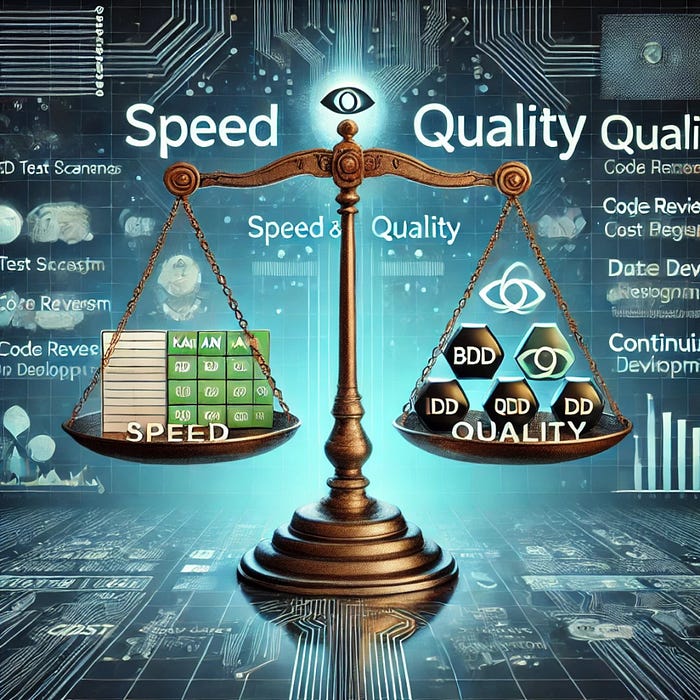

Balancing Speed and Quality in Software Engineering with Scrum, BDD, DDD, Kanban, Azure, and Best Practices
In software engineering, balancing rapid delivery with maintaining quality is a constant challenge. Frameworks like Scrum, combined with practices such as Behavior-Driven Development (BDD), Domain-Driven Design (DDD), Kanban, and leveraging cloud platforms like Azure, offer effective solutions. In this article, we explore how these approaches can be integrated to optimize software development while maintaining quality and security without compromising speed.
Scrum: The Pillar of Agility
Scrum is an agile methodology that organizes development into short cycles called sprints, lasting from 1 to 4 weeks. Each sprint allows the team to deliver functional product increments, enabling continuous feedback and rapid adaptation to changes.
1. Roles in Scrum
Product Owner: Prioritizes the Product Backlog and maximizes product value.
Scrum Master: Facilitates the Scrum process and removes impediments.
Development Team: A cross-functional team delivering usable increments every sprint.
2. Scrum Events
• Sprint Planning: Defines what will be delivered and how.
• Daily Scrum: Daily meetings to synchronize activities.
• Sprint Review: Presents completed work and gathers feedback.
• Retrospective: Reflects on what went well and what can be improved.
3. Scrum Artifacts
• Product Backlog: A prioritized list of features and improvements.
• Sprint Backlog: A subset of the Product Backlog to be worked on during the Sprint.
• Increment: The usable result at the end of each Sprint.
Behavior-Driven Development (BDD) with Gherkin: Aligning Development and Business
Behavior-Driven Development (BDD) promotes collaboration between developers and stakeholders, using a common language to describe the expected behavior of the system. BDD ensures that functionalities are validated continuously, meeting business requirements from the start.
Gherkin is the language used in BDD to write test scenarios in a structured, understandable way for everyone involved in the project. Gherkin follows a simple syntax that adheres to the "Given-When-Then" structure:
1. Given: Defines the initial context of the scenario.
2. When: Describes the action that will be performed.
3. Then: Specifies the expected outcome of the action.
Example of Gherkin:
Scenario: Successful login
 Given the user is on the login page
 When they enter valid credentials
 Then they should be redirected to the homepage
Suggestion: Use BDD with Gherkin to ensure that all requirements are clear and understandable, minimizing rework and maximizing customer satisfaction.
Domain-Driven Design (DDD): Domain-Centric Modeling
Domain-Driven Design (DDD) focuses on creating a software model aligned with the business domain, facilitating communication between the technical team and domain experts.
Suggestion: Use DDD to segment the system into "Bounded Contexts," creating a software model that reflects business processes and reduces complexity.
Kanban: Visualizing Workflow
Kanban is a powerful tool that complements Scrum by providing a clear visualization of workflow. Using a Kanban Board, teams can track the progress of each task, identify bottlenecks, and continuously improve efficiency.
1. Kanban Board: Organizes work into columns representing different task states (e.g., "To Do," "In Progress," "Done").
2. Work In Progress (WIP) Limits: Helps avoid team overload by forcing focus on the most important tasks.
Suggestion: Combine Kanban with Scrum to better visualize workflow, helping the team identify bottlenecks and improve efficiency.
Fibonacci Estimation: Improving Precision
Using the Fibonacci sequence for effort estimation is common in Scrum. Teams use this technique to assess the relative complexity of tasks, helping predict the time required to complete work.
1. Story Points: Teams assign points to tasks based on the Fibonacci sequence (1, 2, 3, 5, 8, 13, etc.), reflecting the effort required.
2. Relative Estimation: By using Fibonacci, teams focus on the relative comparison between tasks, which tends to be more accurate than absolute estimates.
Suggestion: Use Fibonacci to improve the accuracy of effort estimates, making planning and backlog management easier.
Azure: Enhancing Agility and Scalability
Microsoft Azure is a cloud platform that provides a wide range of services for hosting, managing, and scaling applications. Integrating Azure into the development process can boost team efficiency and agility.
1. DevOps with Azure: Azure DevOps offers tools for CI/CD automation (Continuous Integration/Continuous Delivery), facilitating the rapid and reliable delivery of software.
2. Azure Boards: Used to track work, bugs, and features. It can be integrated with the Kanban Board for a clear view of progress.
3. Azure Pipelines: Enables the automation of builds and deployments, reducing delivery time and minimizing errors.
Suggestion: Use Azure DevOps to automate development and delivery processes, ensuring software is continuously tested and deployed securely.
Repository Security: Protecting Codebases
Ensuring repository security is crucial to protecting software against unauthorized access and data loss.
1. Multi-Factor Authentication (MFA): Implementing MFA is essential to secure repository access.
2. Code Review: Use Pull Requests to ensure that all changes are reviewed by multiple developers.
3. Regular Backups: Keep frequent backups of repositories to prevent data loss.
Suggestion: Take a proactive approach to repository security by implementing MFA, enforcing strict code review policies, and maintaining a robust backup plan.
Pull Requests and "Definition of Done"
Pull Requests (PRs) and the "Definition of Done" (DoD) are crucial to ensuring that delivered work is production-ready.
1. Pull Requests: PRs should be mandatory, with every code change reviewed by other team members.
2. Definition of Done: The DoD should include criteria such as completed tests, approved code reviews, and updated documentation.
Suggestion: Ensure that everyone on the team understands and agrees on the DoD, and use PRs to maintain code consistency and quality.
Soft Skills and Continuous Process Improvement
Soft skills are essential for the success of any development team. Effective communication, empathy, and conflict resolution are vital for efficient collaboration.
Suggestion: Promote soft skills within the team and use retrospectives to identify and implement continuous improvements in the development process.
Conclusion
Integrating Scrum, Kanban, BDD with Gherkin, DDD, Fibonacci estimation, Azure, repository security practices, Pull Requests, a clear "Definition of Done," and a focus on soft skills and continuous improvement is essential for achieving a balance between speed and quality in software development. When these practices are applied correctly, they not only increase team efficiency but also ensure that the software delivered is secure, of high quality, and aligned with business goals.
By adopting these approaches, your team will be better equipped to address the complexities of agile development, consistently delivering products that not only meet but exceed customer expectations. This strategy provides a comprehensive and practical framework for integrating methodologies and best practices, ensuring a balanced focus on both speed and quality throughout the entire project lifecycle.