

In a different real-world project, I served as a Cloud Engineer with a focus on DevOps. Within this role, I successfully developed and deployed an e-commerce Minimum Viable Product (MVP) on the AWS platform in under two hours. This entire process was automated using Terraform and Ansible, following the principles of Infrastructure as Code (IaC).
My responsibilities included orchestrating the provisioning of infrastructure through automated processes utilizing Terraform and Ansible. This automation extended to configuring the management processes, installing software, and handling package management for the EC2 instance. The project was implemented using technologies such as Magento, PHP, MySQL, and Redis to ensure its successful completion.
Project Solution Architecture:

Automation with Terraform and Ansible Terraform Overview Terraform is a robust open-source Infrastructure as Code (IaC) tool designed for automating the deployment and management of cloud infrastructure. Its declarative approach allows users to define cloud resources using a high-level configuration language. Supporting multiple cloud providers, Terraform facilitates the creation and management of virtual machines, networks, storage, and load balancers with ease.
Ansible Overview Ansible, another powerful open-source automation tool, focuses on configuration management, application deployment, and task automation. Utilizing a straightforward YAML syntax, Ansible enables the definition of infrastructure and application configurations as code. With Ansible, tasks like software installation, server configuration, and application deployment become streamlined and automated.
Key Technologies in Web Development and E-Commerce Magento Magento stands out as an open-source e-commerce platform empowering businesses to establish and manage online stores. Offering features such as catalog management, order processing, payment integration, and customer management, Magento is constructed using PHP and relies on a database management system for data storage.
PHP (Hypertext Preprocessor) PHP, a widely adopted server-side scripting language, is renowned for its simplicity, flexibility, and scalability. It is commonly employed in developing dynamic web applications, content management systems, and e-commerce platforms that interact with databases.
MySQL MySQL, a prevalent open-source relational database management system (RDBMS), organizes data in tables. Recognized for its reliability, scalability, and user-friendly interface, MySQL is frequently used in web applications for storing and managing large datasets.
Redis Redis, an open-source in-memory data structure store, serves as a versatile tool for databases, caching, and message brokering. Acknowledged for its high performance, low latency, and scalability, Redis is commonly integrated into web applications to store frequently accessed data and enhance response times.
Infrastructure Provisioning and Project Execution To automate the configuration management process, software installation, and package management for an EC2 instance, I leveraged Terraform and Ansible for seamless infrastructure provisioning. Additionally, the successful execution of the project involved the utilization of Magento, PHP, MySQL, and Redis, ensuring a comprehensive and efficient solution.
To initiate this hands-on project, I first registered on the Magento marketplace. Subsequently, I established an account to acquire access keys, enabling the configuration of Ansible for the e-commerce website.
Upon securing the access keys from the Magento marketplace, I initiated AWS Cloud Shell and installed Terraform. This enabled me to provision the essential resources required for the subsequent stages of the project.
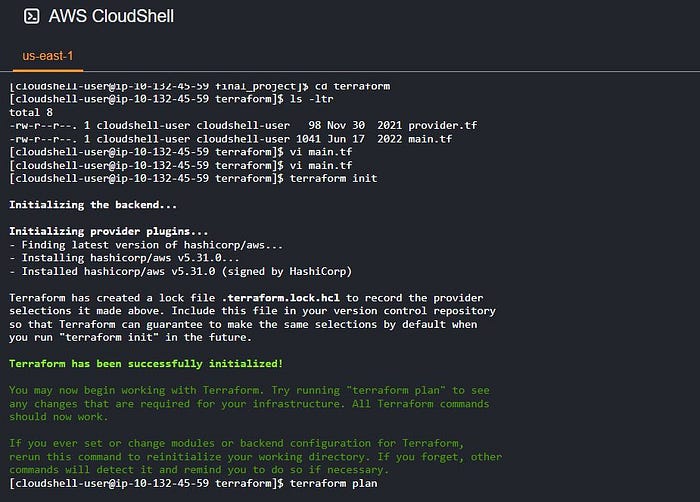


Having effectively provisioned the EC2 instance, I then secured a SSH connection to this virtual machine. Following this, I proceeded to install Ansible, a powerful configuration management tool essential for automating the deployment and configuration of additional software on the instance. This methodology streamlined the setup process, guaranteeing an efficient and dependable system configuration.


In one of the provisioning files, I integrated the initial access keys generated when I created my Magento account. These keys played a crucial role as they allowed Ansible to access my Magento repository, enabling the installation of the required e-commerce platform on the EC2 instance. Furthermore, I adjusted the Magento domain and server hostname to match the IP address of the provisioned EC2 instance. This adjustment was essential in establishing the EC2 instance as the endpoint for the e-commerce website, ensuring its accessibility upon completion. Refer to the details below.


In a brief period of 4 to 6 minutes, I installed the Ansible package on the EC2 instance without encountering any issues.
Following the successful installation of Ansible, I accessed the Magento sign-in interface by entering the EC2 instance's IP address into the URL, initiating the configuration process for the e-commerce website.
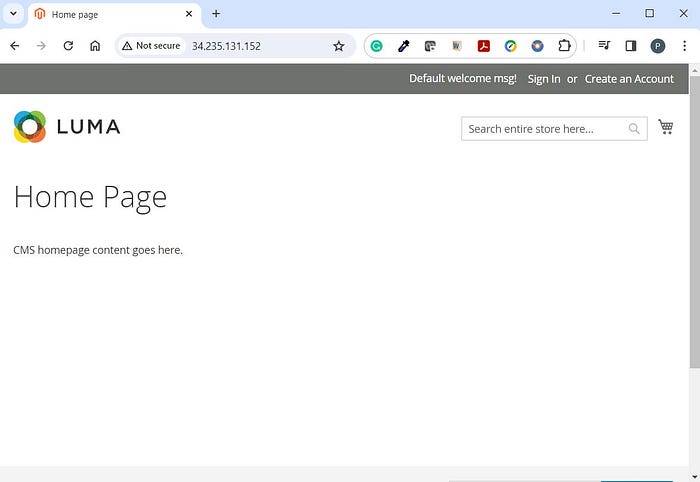

Subsequently, within the dashboard, I set up the home page title, logo, and welcome message for the store view. Then, I configured the store catalog by including various product details such as type, price, available quantity, and images. Afterward, I edited the Home Page to showcase the updated catalog list and exhibit the products on the storefront. To conclude, I verified the modifications by checking the current store home page through the customer view link. This ensured the effectiveness of the changes and confirmed that any customer could access the client store and purchase any available product.


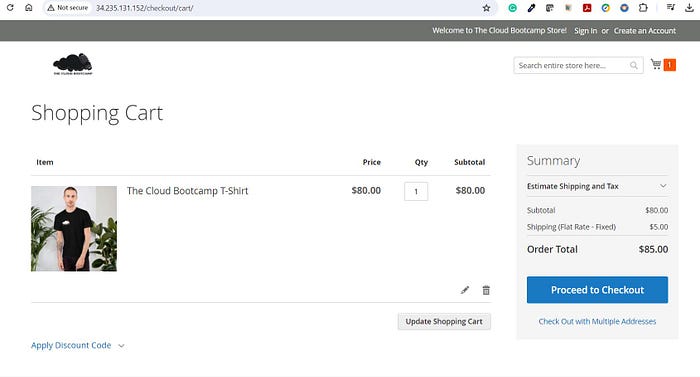
Conclusion:
Utilizing Terraform, Ansible, PHP, Magento, MySQL, Redis, EC2, and VPC creates a robust suite for automating cloud infrastructure, enabling rapid scalability. With Terraform's code-based infrastructure, Ansible's management, and Magento's features, businesses swiftly deploy and oversee their environments. MySQL and Redis handle data storage, while EC2 and VPC manage computing and network resources, streamlining operations effectively for efficient cloud scalability.
Thank you for reading :)