
Art Spiegelman's Maus: A Survivor's Tale illustrates the life of the author's father, Vladek, during the Holocaust. Vladek, a Jewish man in Poland during World War II, was captured by the Nazis and taken to Auschwitz. Vladek Spiegelman survived the Holocaust and lives on to tell his tale to his son, Art, who was born after the war and did not experience the horrors of the Holocaust firsthand. Because of this, Art feels displaced within his family, as he does not share the trauma his parents experienced. Volume II: "And Here My Troubles Began" shows more focus on Art and his feelings toward his father, which reveals to the reader that Art is insecure in his identity as a whole.

Within the narrative, it becomes clear that Vladek and Art have a strained relationship on both sides. Vladek is disappointed with his son and Art cannot live up to his father's expectations. This strained relationship is explored in their interactions with each other and others in the text. Art frequently explains to his wife, Francoise, that he is frustrated with his father, who wishes Art would have turned out differently. This strained relationship is primarily due to Vladek imposing the identity of his deceased son, Richieu, who did not survive the Holocaust, onto Art. This is especially evident in the last words spoken by Vladek in Maus:
"So… let's stop please, your tape recorder…I'm tired from talking Richieu, and it's enough stories for now…" (Spiegelman 296)
Art reveals his insecurities regarding his brother as a sense of rivalry with him, as he feels that Richieu would have been the ideal son, while Art himself feels he let his parents down. Vladek and Richieu shared the experience of the Holocaust, though Richieu did not survive. However, Art feels that Richieu would have made his parents proud, stating:
"The photo never threw tantrums or got in any kind of trouble… It was an ideal kid, and I was a complete pain in the ass. I couldn't compete… They didn't talk about Richieu, but that photo was a kind of reproach. He'd have become a doctor and married a wealthy Jewish girl… It's spooky having sibling rivalry with a snapshot." (Spiegelman 175)
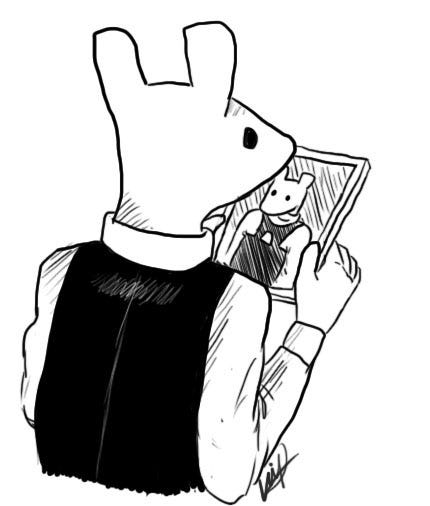
For Art, his artistry was not enough for his father, and he states that, " No matter what I accomplish, it doesn't seem like much compared to surviving Auschwitz" (Spiegelman 204). However, as written by Andrew Gordon, one of Art's goals in writing Maus is "to expose the father and to triumph over him through art." Another goal, as explained by Victoria Elmwood¹, was to "provide a means by which he narrates himself into the family legacy without appropriating the experience of the Holocaust as his own."
Despite Art's attempts to triumph over his father through his writing, Art still experiences a rift in his identity. In Emily Budik's essay, "Forced Confessions: The Case of Art Spiegelman's Maus,"² Budik discusses the rift in Art's identity that occurs because of his father. Art is split between himself, Art, and the idealized version of himself, "Artie." Art is torn between the identity of the idealized son, based on Richieu, that his father wants for him, and his own identity as an artist. Because of this, Art's identity is discursive. According to Smith and Watson, identities "are constructed" and that "autobiographical narrators come to consciousness of who they are" (39).

In a way, Maus is not only the story of Vladek's trauma, but Art's as well. Art shows that his father's expectations deeply affect him and this trauma causes him to be unsure of his identity. This is similar to Mary Rowlandson's experience in captivity, where her trauma causes her to be unsure of her identity, whether it be the identity she had before being captured or the identity that she developed because of her trauma. Art, who isolated himself from his father in adulthood, develops his identity as an artist. When he reconnects with his father for the purpose of writing Maus, he begins to become unsure of his identity. Art takes on his alternate identity of Artie when speaking with his father, and it is Artie who tells his father's tale in Maus.
Throughout Maus, the story of Art becomes clear. It is the story of a man unsure of his place in his family and within himself. Although he attempts to overcome his father through his writing, Vladek's last words imprint the identity of Artie onto Art without giving him the opportunity to contest it, forcing Art Spiegelman to live with both his identity and the identity of Artie even after Vladek's death.
- Elmwood, Victoria A. "'Happy, Happy Ever After': The Transformation of Trauma Between the Generations in Art Spiegelman's 'Maus: A Survivor's Tale.'" Biography, vol. 27, no. 4, 2004, pp. 691–720., doi:10.1353/bio.2005.0006.
- Budick, Emily Miller. "Forced Confessions: The Case of Art Spiegelman's Maus." Prooftexts, vol. 21, no. 3, 2001, pp. 379–398. JSTOR, JSTOR, www.jstor.org/stable/10.2979/pft.2001.21.3.379.