
I suppose that I should point out that I am technically a trained historian. I majored in history, its one of my strengths. And while I can't say that I particularly like getting academic about, well, anything. Sometimes I have to let my inner historian take over. This is one of those times. I don't have a reason for wanting to talk about this subject in particular, other than the vague hope that I can show people books they might not have heard of before, especially if they have an interest in where their favorite genre came from.
Just a few things before we get started, this is by no means a comprehensive history. This essay is meant to be an elementary introduction to the Fantasy genre as it exists today. I also won't be talking about related genres like Science Fiction or Horror in any great detail. Although the three do often overlap, they are fundamentally different and deserve to be discussed on their own terms. With that out of the way, let's get started.
I. Beginnings.
Now from a historical standpoint, when talking about the history of any genre of speculative fiction, you're mostly talking about both the literary traditions and popular culture of two countries, Europe (notably The United Kingdom for our purposes) and The United States. Yes, other countries developed their own flavors of the genre, but their history starts in the middle of the story I'm telling and are heavily influenced by the writers from the countries mentioned above. And most of the prominent genre authors from other countries, particularly those from Asia, would remain virtually unknown to the rest of the world until the invention and wide-spread use of the internet. That doesn't make it right, wrong or indifferent, that's just the way it was.
Now obviously, the fantasy genre has its roots in mythology, the epic poems of the Greeks, Romans, Germans and other cultures, the romance stories of the middle ages, fairy tales, and the artistic and scientific revolutions of the Renascence. But pointing to the exact birthday for Fantasy is not as simple as it sounds. That's because a lot of work before the 19th century didn't always have clear boundaries between Fantasy and other genres. Probably the most well-known example of this are the works of Shakespeare. Although many of his plays, such as Hamlet and Macbeth, had fantastical elements, they are not considered part of the fantasy genre. Why? Because the fantastic serves only as a convenient plot device and could still work without the fantastical element with a little rewriting.
It wasn't until the late 19th and early 20th century that the genre as we know it started to take shape when Scottish author George MacDonald published the children's novel The Princess and the Goblin in 1872 and the more adult-themed Phantastes in 1858. The latter of which is considered the first fantasy book for adults. The other pioneer of modern Fantasy was English poet William Morris, who is most famous for the book The Well at the World's End. Morris's work was the first to introduce the idea of setting the story entirely in a self-contained fantasy world. At the time, it was a pretty bold idea because no one had ever thought to create an entire fictional world to set a story in before. Morris' was also a fan of the medieval romances and heroic sagas, and this is reflected in his fantasy work via its deliberate archaic style of narration and medieval setting, which is why every fantasy author and their grandmother has used it ever since.
II. The Gods, the Serpent, and the Children:
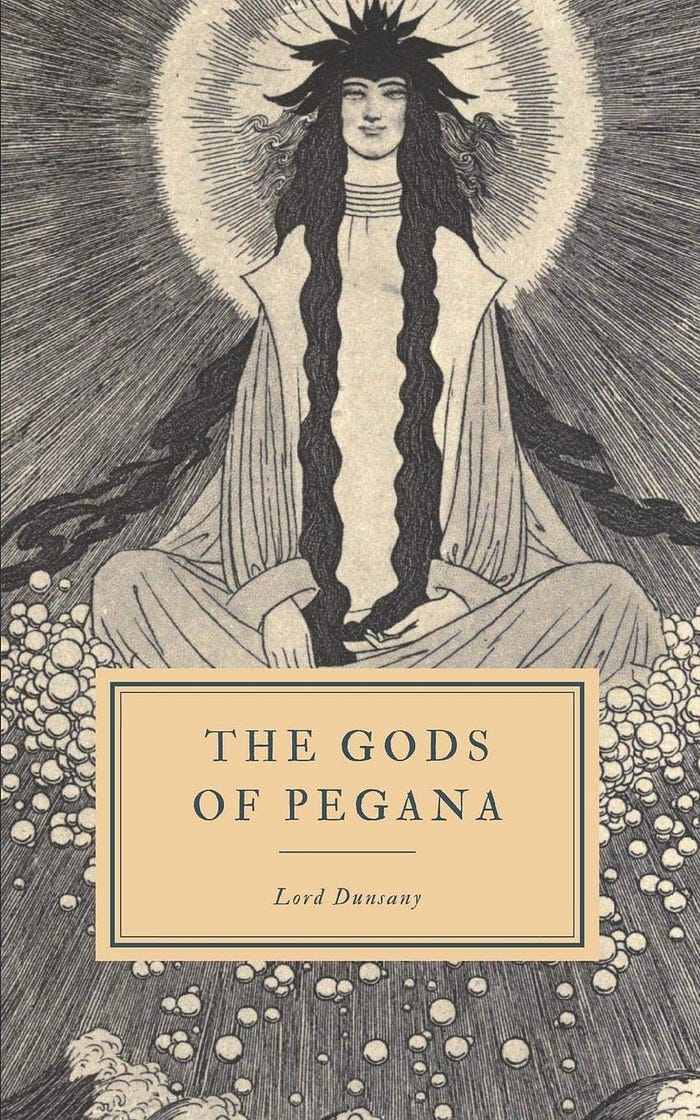
Even though both MacDonald's and Morris's work was successful and popular for their time, the genre they helped create didn't gain a wide audience until the turn of the century with the debut of Lord Dunsany and his novel The Gods of Pegāna in 1905. Like Morris, Dunsany set his story in a fantasy world, but he also added a layer of depth by inventing his own pantheon of gods for his world's inhabitance to worship. Overtime, Dunsany would expand upon and add to his world's culture, history, and what have you. It's for this reason that he's often considered the godfather of world-building. On the other hand, his narration style was really pretentious, grandiose and, well, really really kinda silly. Here's an example:
Some say that the Worlds and the Suns are but the echoes of the drumming of Skarl, and others say that they be dreams that arise in the mind of MANA because of the drumming of Skarl, as one may dream whose rest is troubled by sound of song, but none knoweth, for who hath heard the voice of Mana-Yood-Sushai, or who hath seen his drummer?
And somehow this influenced an entire generation of writers who tried to imitate his style. But I digress.
The late 19th and early 20th century was also the time when all the classic children's fantasies made their debut, starting with Lewis Carol's Alice in Wonderland in 1865, L. Frank Balm's Wizard of OZ in the year 1900, J.M. Barrie's Peter Pan in 1904, and countless others. The success of which, while all essential steps in the development of the genre, also helped solidify the stigma that Fantasy is only supposed to be for children and that as such, fantasy novels geared towards adults were considered distasteful. Honestly, this idea was not unique to this time, as its more or less the same way people view Fairy Tales, both then and now. But wouldn't stop the development and eventual mainstream acceptance of the genre.

Such was the case with the next big event in the development of the genre when in 1922, English civil servant and author E.R. Eddison published one of the seminal works of modern Fantasy: The Worm Ouroboros. While the book has little in the way of Mythopoeia/world building, Ouroboros was a hedonistic epic, unlike anything the genre had seen before. And would set the benchmark for the genre for the next 32 years. It was also a critical darling and was also a favorite of two professors teaching at Oxford, but we'll come back to them.
III. Dreams of Pulp, and Halflings.
Meanwhile, in America, one year after Ouroboros was published; the first issue of Weird Tales, a pulp anthology magazine dedicated to publishing "Weird" genre fiction, hit the newsstands. While it wasn't the first magazine of its kind, it did debut some of the most iconic creators in the history of speculative fiction such as Robert E. Howard (creator of Conan the Barbarian), Fritz Leiber (creator of Fafhrd and the Gray Mouser), and H.P. Lovecraft (creator of the Cthulhu Mythos).

Lovecraft, in particular, is worth a special mention here. Although he's right considered one of history's great horror writers, His contribution to the Fantasy genre cannot be understated. You see, Lovecraft's Mythos took Lord Dunsey's idea of a fictional pantheon of gods and turned it into something dark and sinister. To Lovecraft, the gods are not beautiful, but monstrous, other-worldly evil beings whose very existence must remain secret less the human race sanity, and very survival be at risk. In other words, Lovecraft's gods don't want to help us. Some want us dead, while others are indifferent to humanity. Neither good nor evil, but an unknowable force. As far above us, as we are above the microbe. This theme of cosmic indifference and existential dread birthed the genre we know as Cosmic horror. But it would also lay the foundations for the sub-genre of Dark Fantasy.

At the same time, Howard and Fritz wrote more traditional Fantasy, but not the magnum-sized epics of Ouroboros. These were bite-sized but exciting serialized short stories that you could read in an afternoon. They were full of magic, swords, beefcake men doing heroic deeds in leather & loincloths, damsels in distress, and chicks in chain mail. This sort of low Fantasy was the beginnings of the sub-genre known as 'Swords and Sorcery.' These kinds of stories weren't meant to be taken too seriously. They were just for fun. Now that's not to say that any of those stories were terrible, far from it. But they also weren't moving the genre forward either. By the 1930s, pulp Swords and Sorcery had become the dominant genre. But were only one step above comic books in terms of literary significance, something to be enjoyed and then put away at the outset of adulthood.
While Weird Tales and their ilk kept pumping out Conan, an Oxford Professors was hard at work writing a new fairy tale for his children. A story about a little man named Bilbo Baggins as joined 13 Dwarves on their quest to reclaim their homeland from a dragon named Smaug. The Professor was J.R.R. Tolkien and the book was The Hobbit. Released on September 21, 1937. The Hobbit was an instant classic, winning praise in leaps and bounds and was even nominated for the Carnegie Medal. And while it is a children's book at heart, the story was smart and sophisticated enough to appeal to everyone, adult and child alike. Not only that, Tolkien's fantasy world of Middle-Earth was the most extensive and realistic ever seen at that point, toppling Ouroborus as the standard by which all others after must be compared. However, Tolkien had originally never intended for The Hobbit to be set in Middle-Earth. You see, Tolkien had started developing the world of Middle-Earth when he was 17. It wasn't until many years later that he discovered that yes, The Hobbit was part of this Mythology he was creating. And this discovery would influence the squeal. When the Hobbit turned out to be a hit, his publishers obviously wanted him to write more. Tolkien agreed and set to work. His original plan was to write a much simpler story in where Bilbo goes out to find more treasure, but as the work progressed, this idea was abandoned. But Tolkien would find another story in the smallest element of The Hobbit. And the tale that Tolkien wrung out of that, no one saw coming.
IV. One Ring and The Lions in the Wardrobe.
That story was his magnum opus and arguably one of the greatest books ever written: The Lord of the Rings. Originally intend to be told in one volume, the book was so massive that the publisher decided to publish the work as a trilogy, which was published from 1954–1955. I cannot stress enough just how important The Lord of the Rings is to the history of the genre. It is one of those once in a lifetime books that changes everything. Not only did it up the bar for the depths and complexity that was possible for a fantasy story, but it also set the popular image of the genre that endures to this day and probably for the rest of time. Everything you think of when you think of modern Fantasy started with Lord of the Rings. While Tolkien didn't create these elements, Lord of the Rings did put them into the popular imagination.
Some years before the publication of Lord of the Rings, however, in 1950, Another Oxford Professor published the first in a series of children's novels. It was a story about a group of siblings who discover a magical world after walking through an unassuming looking wardrobe. The author was Tolkien's good friend and celebrated Christian Scholar Clive Staples Lewis and the series was The Chronicles of Narnia.
In essence, what Lord of The Rings did for Fantasy for adults, Narnia did for children. Although nowhere near as complex as Lord of the Rings, Narnia's shared mythology, world, and the interconnected story did lay the foundation for what young adult fantasy would eventually become, paving the way for modern YA classics such as Artemis Fowl, and Harry Potter. Both Lord of The Rings and The Chronicles of Narnia are considered the fathers of modern Fantasy, and their popularity and influence have only continued to grow.
V. Wizard Schools.
I'm gonna let you all in on a little secret: the reason why not many people remember the balk of the works published immediately after Tolkien and Lewis is that a lot of it was reactionary. Aspiring fantasy authors read Tolkien and Lewis and tried to imitate them with mixed results. And while some of that would endure, like Terry Brook's Shannara series, others were put away and promptly forgotten. Also, during the s, 60s, and 70s, Fantasy's spiritual brother, Sci-Fi, started to gain mainstream acceptance and popularity with a little help from TV Shows such as The Twilight Zone, Star Trek, the British show Doctor Who and movies like 2001 and Star Wars. This was further helped along by the emergence of the so-called "New Wave" of Science Fiction and the works of Bradbury, Herbert, Heinlein, Asimov, and Clarke. But among those grandmasters: one would stand out and break the chains of mediocrity that had taken hold of the Fantasy genre. The best way to describe her would be this way: if Tolkien and Lewis are the fathers of modern Fantasy, then Ursula K.LeGuin is its mother, when in 1969 she published the first book in her now-legendary Earthsea cycle, A Wizard of Earthsea.
In terms of plot, A Wizard of Earthsea is your basic "coming of age" type story, But it's vital to our history of the fantasy genre because it introduced a plot element that has since become standard to the genre. Namely, a school of magic where potential wizards can learn their trade (where do you think J.K. Rowling got the idea for Hogwarts).
Of course, magic has always been apart of the genre. It's part of the appeal, after all. But until Earthsea, magic had always been this limitless omnipotent power that can do pretty much anything. Leguin changed all of that. For really the first time, magic had set rules, limits, and real consequences. And even the ones who use it don't fully understand it. In other words, Leguin had made magic realistic. Not realistic in the sense that it couldn't do impossible things, but realistic in the sense that it was no longer this cosmic force that can do anything, and only a few select people could learn. She made it more like a science, and just like any field of science, it can be taught. And that's where the school of wizardry comes in. Having a school where any damn fool can learn magic was pure genius. And added a depth of believably that hadn't been seen since Tolkien.
VI. A Dragon in my Dungeon.
Do you know what else happened in the 1970s? Gary Gygax and Dave Arneson formed a game company called TSR (now Wizards of the Coast). They released the first edition of Dungeons and Dragons, a tabletop role-playing game that let anyone gather their friends and go on an adventure with the relative safety of miniatures, 20 sided dice, stacks of rule books and a game board. Since then, D&D has become one of the most popular and well-known games in history and continues to evolve with constant revisions. Now, why the heck am I telling you this?

Well, the reason is that, unlike other board games, D&D has several worlds for players to get immersed in. And while players have the freedom to make their own adventures, the story of the worlds themselves is told through other media, particularly books. Writers are regularly hired to create characters to populate the worlds and then write about them. This is what is known as a "Shared World." The most well known of these to have the D&D name are Dragonlance, created by Tracy Hickman and Margaret Weis, and Forgotten Realms. The most well-known writer working in the latter being R. A.Salvatore, whose Dark Elf character, Drizzt Do' Urden, is the reason why D&D gets a mention. The first book to feature the character, The Crystal Shard, was first published by TSR in 1988. While there are limits as to what writers can do with a licensed property, Salvatore was fortunate enough to be given enough creative freedom to make the Drizzt unique. What makes him so unique? Its because he's a Dark Elf, a race of elves that are considered evil. And although Drizzt is a hero, he's treated by others with fear and hatred simply because of what he is, not who he is. With Drizzt, Salvatore was able to talk about an issue that was rarely discussed in mainstream Fantasy, the issues of racism. That might not seem like a big deal now, but back then it was. And it was a welcomed breath of fresh air because by the 1980s the genre was growing stale.
VII. Growing up with Wheels of Ice and Fire.
While the 1980s and 90s saw the debut of many modern big shots authors such as Robin Hobb, Terry Pratchett, and comic book writer turned novelist Neil Gaiman. There hadn't really been anything published that could be said to rival the works of Tolkien. Although the genre was still a top seller, everyone seemed to agree that the conventions that Tolkien had created were now cliche and were running out of steam. To be fair, It wasn't all bad, Terry Pratchett, for example, was able to keep his work fresh by satirizing the conventions of the genre. And Neil Gaiman eventually helped pioneer the sub-genre of Urban Fantasy with his novel, Neverwhere, in 1996. But even so, in the 1980s, there didn't seem to be any series on par with Tolkein. The genre as a whole needed a shot in the arm. And boy, was it about to get it in a big way.
It started, innocently enough, in 1982 with the release of a movie based on Conan the Barbarian, starring Arnold Schwarzenegger and James Earl Jones. The film was a hit, and publishers, looking to cash in on its success, decided to hire people to write new adventures for the character. Chief among these was historical fiction author James Oliver Rigney, Jr. Rigney would go on to write a total of 7 Conan books, including the novelization of the film's not great sequel. But even as he worked on these books, Rigney was already planning his next project, a fantasy epic that would not only make him a household name but also finally succeed where so many others before him had failed…match (and some would arguably surpass) The Lord of the Rings.

Writing under the same pen name he'd used for the Conan novels, Robert Jordan, the first part in Rigney's epic Wheel of Time saga, The Eye of the World, was published on January 15, 1990. While the story does admittedly retain some tropes of the genre, several things make The Wheel of Time stand out. For example, The traditional fantasy races of ogres and Elves are nowhere to be seen. In their place, we have a new species, Ogeir, which combines the nature-loving aspect of the Elves with the physical appearance of giants or Ogres. Other fantasy races like Dwarfs, Hobbits, and what have you are also not present either. Rigney wanted people, or at least psychologically real characters, avoiding all the major cliches and, while at the same time, maintaining the level of imagination and that we've come to expect. A balance that not many can actually pull off.
Also, this series sets itself apart with its theme of the nature of trust. Rigney said that he got the original idea for the series by asking the question, "What would it be like to be told that you're destined to save the world?" And his answer was that it would not be like what it was in many stories. He thought that selfishness would play a role, as would lust for political power. It creates a situation where despite this looming apocalyptic event, people in power are more concerned with petty struggles and their own positions, creating a situation where the chosen one would never be sure of most of his so-called allies. This shade of grey marked a turning point for the genre. After so long in stagnation, it was finally starting to move out of the shadow of Lord of The Rings and gain mainstream acceptance as both serious literature and works of art.

And within the same decade, that acceptance would come to fruition. When in 1997, another series began that would take that turning point and push it to its logical, and it must be said very dark extreme. The series is George R. R.Martin's Song of Ice and Fire series, more famously known as Game of Thrones.
And that pretty much up leads us to the present state of affairs. I could have talked about this for another few hours, but I had to stop somewhere, and Song of Ice and Fire seemed to be the logical place. I hope you all enjoyed this and found it informative.
Originally published at http://thesummersleeper.blogspot.com.