

What is Design Thinking?
Design thinking is a method that teams follow to better understand their users. It's not a straight-forward process; it involves repeating certain steps and revisiting previous ideas. This method helps teams question and challenge their initial assumptions. The main goal is to come up with new and creative solutions. These solutions are then made into prototypes which are tested. It's especially helpful for problems that don't have a clear or known solution.
Here's an excerpt from the man who coined the term himself:
"Design thinking can be described as a discipline that uses the designer's sensibility and methods to match people's needs with what is technologically feasible and what a viable business strategy can convert into customer value and market opportunity."
– Tim Brown CEO, IDEO
Building on Tim Brown's perspective, the term "Design Thinking" might be a relatively recent coinage, but its conceptual roots stretch back to the 1960s in America. It was the Nobel Prize winner Herbert Simon who, in his 1969 book "The Sciences of the Artificial," outlined one of the foundational models for Design Thinking. Simon detailed a process with seven stages, each comprising specific activities. Over the years, various adaptations of Simon's framework have emerged. Though the number of stages may range from three to seven in different models, the core principles established in 1969 remain consistent across them.
1. Stanford University d.school model
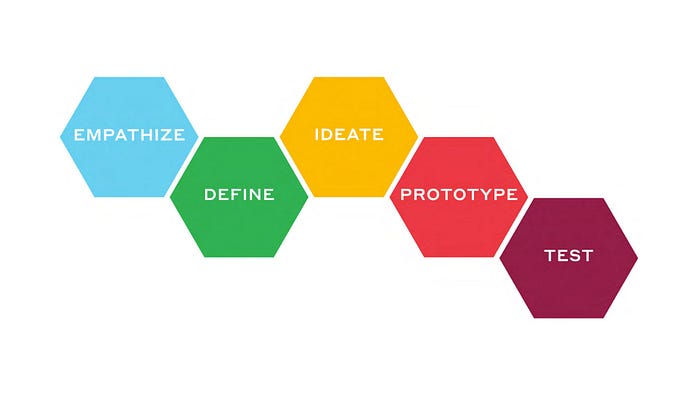
Stage1: Empathize
- Engage in a conversation with a partner to understand their personal experiences and perspectives. This is the first step to gaining insights into their challenges and needs.
- After the initial discussion, go back and ask follow-up questions. Dive into the specifics of their stories and emotions to gain a richer understanding.
Stage2: Define
- Reflect on the collected information and insights from the conversation.
- Identify the central needs of your partner and pinpoint any particularly interesting or unexpected discoveries.
- Using this understanding, clearly articulate the main problem or challenge that you want to address. This becomes the focal point for the next stages.
Stage3: Ideate
- Clearly state the problem you've identified.
- Spend time brainstorming, and sketch various solutions to this problem. Aim for diversity in your ideas to explore multiple possibilities.
- Share the sketches with your partner and gather their feedback. Based on this feedback and further reflection, conceptualize a refined or entirely new solution that you believe would best address the problem.
Stage4: Prototype
- Taking your refined idea, create a tangible representation or model of the solution. This can be as simple as a paper mock-up or a basic physical representation.
- The goal isn't to make a finished product but to create something tangible that your partner can interact with. This gives them a clearer idea of how your solution might work in practice.
Stage5: Test
- Present your prototype to your partner and observe their interactions and reactions.
- Actively listen to their feedback without getting defensive about your prototype. Remember, the goal is to learn and iterate.
- Write down their comments, especially noting aspects they liked or didn't resonate with. Pay attention to any new ideas or suggestions they might offer.
2. 3i model of IDEO

inspiration
・Inspiration in design thinking emerges from a deep dive into the human experience, understanding people's needs, desires, and motivations. ・Remain open, curious, and see every challenge as an opportunity. ・Adopting a "beginner's mind" is essential to truly understand and derive inspiration from the people we're designing for.
ideation
・Ideation is the heart of the creative process in design thinking. It's about dreaming wildly, generating a plethora of ideas without the constraints of feasibility initially. ・The process involves tinkering, testing, and being ready to embrace failure as a stepping stone. ・The designer's mindset during ideation is fueled by empathy, optimism, creativity, and the thrill of ambiguity. ・It's about seeing possibilities where others see obstacles and continuously iterating to refine ideas.
implementation
・This phase is about taking the best solutions derived from ideation, refining them, and making them tangible. ・The aim is to create solutions that resonate deeply with the people they're designed for. ・It's about achieving optimal solutions that not only meet but exceed human needs. ・ Not just about achieving an end result but ensuring that the end product or service truly makes a difference in people's lives, anchored by a solid foundation of research, testing, and feedback.
3. Herbert Simon: 7Stage design process

Define:
Determine the primary issue and audience, ensuring project urgency is prioritized. Set benchmarks for success and establish a common terminology.
Research:
Examine the issue's history and understand past solutions. Engage with stakeholders, including end-users and experts, to gather diverse insights.
Ideate:
Focus on understanding end-users' needs and motivations. Facilitate open brainstorming sessions, encouraging a free flow of ideas without judgment.
Prototype:
Refine and expand on brainstormed ideas, creating multiple drafts. Gather diverse feedback, including from end-users, and develop functional prototypes.
Choose:
Revisit the project's goals, objectively evaluating the ideas. Emphasize selecting the most impactful ideas, rather than just the most practical ones.
Implement:
Outline and allocate tasks, ensuring resources are available. Execute the plan and present the final product to the client.
Learn:
Collect consumer feedback post-implementation to assess if goals were met. Analyze outcomes, consider improvements, and document findings for future reference.
4. The Double Diamond Model

Discover:
The first diamond helps people understand, rather than simply assume, what the problem is. It involves speaking to and spending time with people who are affected by the issues.
Define:
The insight gathered from the discovery phase can help you to define the challenge in a different way.
Develop:
The second diamond encourages people to give different answers to the clearly defined problem, seeking inspiration from elsewhere and co-designing with a range of different people.
Deliver:
Delivery involves testing out different solutions at small-scale, rejecting those that will not work and improving the ones that will.
(Cited by : https://www.designcouncil.org.uk/our-resources/framework-for-innovation/)
・It emphasizes both expansive exploration (divergent thinking) and specific action (convergent thinking). ・This process isn't strictly linear; insights can redirect teams to earlier stages. ・Early idea testing can aid discovery. ・Given the evolving nature of our digital world, ideas continually adapt based on feedback and iterative improvements.
5. AIGA: Head, Heart and Hand
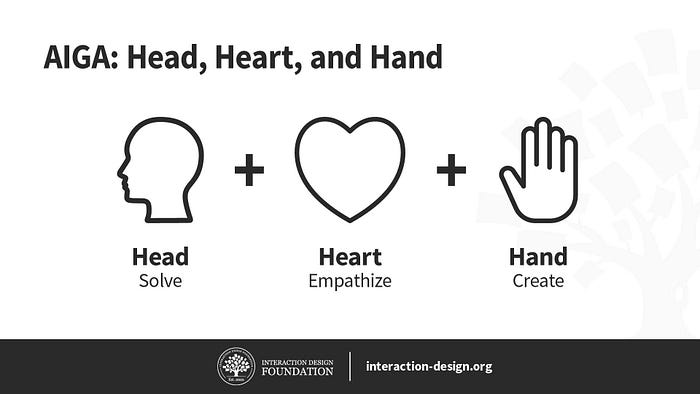
The American Institution of Graphic Arts (AIGA) emphasizes the holistic approach of modern design, merging head, heart, and hand.
Designers use their intellect to tackle intricate challenges. They employ empathy in initial stages to comprehend human emotions. Their distinct skill lies in hands-on creation. This combination of attributes ensures a comprehensive and successful design process.