


In 1994, archaeologist Klaus Schmidt stood on a dusty hilltop in southeastern Turkey, squinting against the sun. He hadn't even intended to focus on this site — the cosmic irony of stumbling upon humanity's oldest temple while looking for something else entirely isn't lost on archaeologists today. Originally in the region to study early farming, Schmidt decided to investigate the hill after reading a brief mention in an earlier survey. The academic equivalent of finding your car keys while looking for your phone.
Local farmers had long treated the hill with superstition, plowing around strange stones that kept emerging from the ground. Rather than remove these agricultural speed bumps, they'd work around them, creating odd patterns in their fields that, viewed from above, looked like a drunk giant's game of connect-the-dots.
When Schmidt started digging, what emerged wasn't just another archaeological find — it was an intellectual earthquake that would crack the foundation of everything we thought we knew about human civilization.
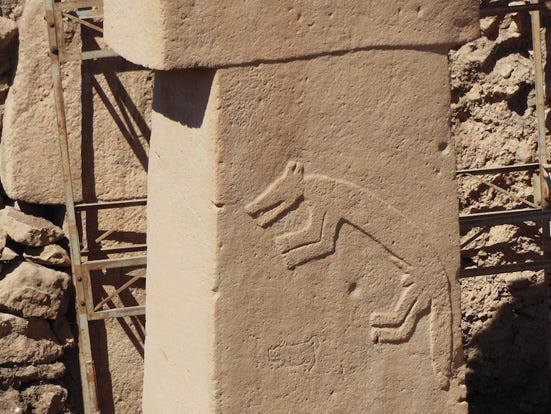
Göbekli Tepe — "potbelly hill" in Turkish, a name with all the grandeur of calling Stonehenge "some rocks in a field" — had kept its secrets buried for nearly 10,000 years. As Schmidt's team carefully brushed away millennia of dirt, they uncovered massive T-shaped pillars arranged in perfect circles, their limestone surfaces crawling with carved snakes, foxes, and birds so lifelike they seemed ready to leap off the stone. Carbon dating delivered the intellectual sucker punch: these sophisticated structures were created 11,600 years ago — 7,000 years before the Great Pyramid of Giza and 6,000 years before Stonehenge.
The problem? According to everything archaeologists thought they knew, the people who built Göbekli Tepe shouldn't have been able to build much of anything at all — let alone a sophisticated temple complex. It's like discovering your toddler built a fusion reactor in the sandbox while you weren't looking.
Missed Connections: The Temple That Archaeologists Kept Friendzoning
Schmidt wasn't the first archaeologist to visit the hill. In 1963, a joint Turkish-American survey had dismissed it as a medieval cemetery of little importance — archaeology's equivalent of walking past a winning lottery ticket. History has a way of hiding in plain sight, patiently waiting for someone to actually pay attention.
Today, approaching Göbekli Tepe feels like walking toward a stage where history performed its most dramatic plot twist. The site sits high on a ridge of the Germuş mountains, with views stretching toward the Syrian border. Standing here, you can turn a full circle and see for miles — a natural watchtower visible to anyone within a day's journey.
What immediately strikes visitors are the massive T-shaped pillars — limestone monoliths standing up to 18 feet tall and weighing as much as 16 tons. Stone Age engineering that would make modern contractors sweat. The largest circle spans 65 feet across, with two central pillars surrounded by slightly smaller stones all facing inward like a prehistoric board meeting that's been going on for 11,000 years.
Twenty circular enclosures have been identified, though archaeologists estimate they've excavated only 5% of the site. The oldest enclosures date to approximately 9600–8800 BCE, when our ancestors elsewhere were still living in small nomadic bands.

Stone Cold Artists: The Original Instagram Without the Filters
If Göbekli Tepe's existence is surprising, the artistry covering its pillars is nothing short of astonishing. Run your fingers over these ancient stones, and you'll feel a menagerie of creatures captured in limestone: foxes stretching their lithe bodies, lions baring their teeth, scorpions with their tails curled. The Neolithic equivalent of an art gallery, but with considerably less pretentious wine and cheese.
Imagine skilled craft specialists using only stone tools to create three-dimensional figures on multi-ton pillars — with no room for error. The prehistoric equivalent of performing brain surgery with oven mitts on. These weren't amateur doodlers but master artists with intimate knowledge of animal anatomy.
Researchers have noted that the animals depicted — lions, boars, foxes, vultures — are consistently dangerous or scavenging species, not animals typically hunted for food. Apparently, our ancestors were more interested in carving predators than prey — a Stone Age fascination with danger that makes modern horror movies seem rather derivative.
The T-shaped pillars themselves bear an unmistakable human resemblance. Some even have arms carved in relief down their sides, with hands meeting at the navel. Most intriguing are the abstract symbols scattered among the animal carvings — H-shapes, circles, and crescents that suggest a form of proto-writing thousands of years before cuneiform or hieroglyphics.

No Tools, No Problem: Engineering Feats That Make IKEA Assembly Look Easy
When radiocarbon dating first established Göbekli Tepe's age, many archaeologists responded with disbelief. The results seemed impossible, like finding a smartphone in a pharaoh's tomb. Test after test confirmed the startling truth: construction began around 9600 BCE. It wasn't the dating that was wrong — it was our understanding of what early humans could achieve.
To appreciate the mind-bending implications, consider what we know about the builders. They had no metal tools. No pottery. No domesticated animals to help with transportation. No written language to record measurements or plans. They hadn't even invented the wheel.
Yet somehow, they quarried 16-ton blocks of limestone, carved them with intricate designs, transported them up to a quarter-mile uphill, and arranged them in precise circles according to a complex architectural vision.
Most perplexing of all: after 1,600 years of use, Göbekli Tepe was deliberately buried. Layer upon layer of sediment was carefully packed around the pillars — preserving them for modern discovery. In a twist of archaeological irony, the site's intentional burial ensured its preservation, while areas left exposed have been damaged by centuries of plowing.
Reading History Backwards: When Your Entire Textbook Gets It Wrong
Before Göbekli Tepe, the story of civilization seemed straightforward: Humans invented agriculture, which created food surpluses, which allowed permanent settlements, which eventually led to complex societies capable of monumental architecture and organized religion. It was a neat, linear progression that appeared in every archaeology textbook — right alongside other things we've been spectacularly wrong about.
Göbekli Tepe upends this narrative completely. Here stood monumental architecture and evidence of complex religious organization — built by people who were still primarily hunting and gathering. No evidence of permanent dwellings has been found. No domesticated plants or animals appear in the early layers. These people hadn't yet settled down to farm, yet they somehow built one of the world's first temples. It's as if we discovered that cavemen had social media before they had fire.
The implications hit archaeology like a thunderbolt. Rather than agriculture enabling religion and social complexity, perhaps it was the reverse — religious gatherings and social organization preceded and possibly motivated the shift to farming.
As Schmidt memorably put it: "First came the temple, then the city."

Ancient Tailgate Parties: Prehistoric Revelry With a Side of Civilization
What exactly happened at Göbekli Tepe? Current research suggests it functioned as a ritual center where normally dispersed groups gathered periodically for ceremonies and feasting. Some structures appear astronomically aligned, possibly marking solstices or other celestial events.
Archaeological analysis has revealed residues of fermented beverages in stone vessels at the site. These people weren't just building — they were celebrating. The world's oldest happy hour, 11,600 years in the making. Analysis of animal bones shows mass slaughter and consumption of wild game, suggesting special occasions drawing people from considerable distances.
Göbekli Tepe might have been Neolithic humanity's first pilgrimage site — a place where scattered communities reinforced social bonds, traded goods and ideas, found mates, and perhaps laid the groundwork for the agricultural revolution.
Ongoing excavations continue to yield surprises. The Taş Tepeler project has identified at least 12 similar sites in the region, suggesting Göbekli Tepe wasn't an isolated phenomenon but part of a wider cultural network spanning southeastern Turkey.
Today, visitors walk on designated pathways above the excavations, gazing down at a sight that would have been inconceivable to archaeologists a generation ago. Despite its profound importance, Göbekli Tepe's remote location means it receives a fraction of the visitors who flock to younger sites like the Pyramids or Parthenon.
As you stand before these ancient pillars, watching the same sun move across the sky as their creators did 11,600 years ago, it's impossible not to feel a connection across millennia. Their monument has achieved something truly remarkable — forcing modern humans to reconsider what we thought we knew about our own story, and reminding us that the past, like the future, may contain more possibilities than we've imagined.
Hitch Your Donkey to a UNESCO Site: Bring Your Camera, Leave Your Confusion
Getting There: Göbekli Tepe lies about 9 miles northeast of Şanlıurfa in southeastern Turkey. Most visitors hire a taxi or join a tour from Şanlıurfa. The final approach involves a bumpy road — consider it a time machine with particularly bad suspension.
When to Visit: Spring (April-May) offers pleasant temperatures and carpets the landscape with wildflowers. Fall (September-October) provides clear skies and moderate temperatures. Summer brings punishing heat — imagine making a pilgrimage to the world's oldest temple while feeling like you're slowly melting.
Practical Tips: Wear sturdy shoes — the terrain is uneven and rocky. Hire a knowledgeable guide; without one, you'll essentially be looking at a bunch of old rocks with weird carvings, missing their mind-blowing significance.