

While on a walking tour with friends in Athens in May 2022, we heard a story passed down through oral tradition. According to Greek mythology, the rock that would later become the Acropolis of Athens was the site of a contest between Athena and Poseidon to be the patron of the surroundings.

Both deities were considered by the local population as two of the Olympic gods. Athena was said to be born as an armored female adult from the head of Zeus, signifying her strength and bravery, ready to defend all she deemed just.
Despite her warrior nature, Athena showed up with an olive tree, which would provide nourishment and precious oil to the area's inhabitants. With a stunning trident strike, the mighty Poseidon summoned a saltwater spring from the verdant landscape.
The legend says the people deemed Athena's gift more valuable than Poseidon's offer of non-drinkable water. A surplus of salty water wasn't a great thing, as they were already based near the Port of Piraeus at the Saronic Gulf, just a few kilometers away. Athena won, and the capital city we know today as Athens was named after her.
Many aspects of Athenian life and culture revolved around Athena's revered figure. Today, a captivating modern representation of Athena can be found next to the remarkable neoclassical building of the Academy of Athens, completed in 1887.

To the ancient Greeks and a small portion of the current population who practice the modern Hellenistic religion, Athena is still seen as the embodiment of wisdom, courage, inspiration, civilization, law and justice, strategic warfare, mathematics, strength, arts, and crafts.
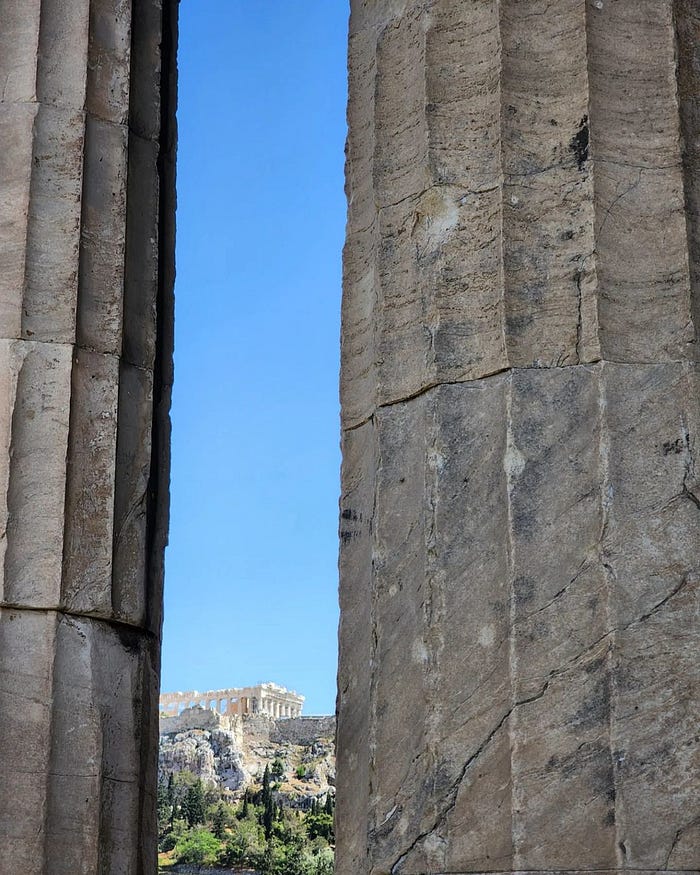
Back in the 5th century B.C., the Athenians erected the Parthenon as a symbol of triumph, marking the Greeks' victorious endings of the Greco-Persian Wars. Its distinctive architectural style and timeless beauty have influenced generations of architects and artists for millennia, leaving a lasting impact on visitors to the archeological site.

Today, the Parthenon is still the most recognizable structure worldwide dedicated to the goddess. The giant statue of Athena Parthenos — Athena the Virgin — inside this temple was approximately 12 meters tall. It was developed under the supervision of the renowned sculptor Phidias, who was also responsible for the decorative work of the entire temple.
The white marble of this temple was originally covered in a layer of gold and ivory dedicated to the goddess Athena. Her figure stood inside and was considered one of the most valuable statues in ancient Greece. Sadly, the colossal Athena Parthenos is believed to have been entirely destroyed.
— Visiting the Acropolis of Athens, in restoring ruins, written by the author
Although the legendary indoor statue is probably lost to history, a surprising number of original fragments of the Parthenon remain, many undergoing restoration and serving as a testament to the ancient Greek civilization and its cultural heritage.

While there may be numerous reproductions and original fragments of the Parthenon on display in museums across the globe, a visit to the actual archeological ruins in Athens reveals that despite repeated destruction, the Athenians have never given up on their Acropolis. They have persevered in their efforts to document and preserve Athena's citadel.
From a cultural viewpoint, the presence of this deity can be seen in an extensive range of ancient and contemporary literature, art, and religion. Athena's name holds great significance and is still referenced in universities and cultural centers worldwide. A simple search in Google Maps would reveal over 30 cities and towns across the USA, with a few more located in Europe and Central America that have been named after her. This highlights the impact she has had on the imagination of a considerable number of people across the world.
From the heights of the Acropolis to the furthest corners of the modern world, the constructed idea of Athena continues as an eternal triumph of the human spirit over the forces of destruction and decay. As civilization advances, there will be even more to uncover as the cultural heritage built around the concept of this goddess inspires future generations.
You can view more pictures from my experiences in Greece and other unique locations on my Instagram photoblog.