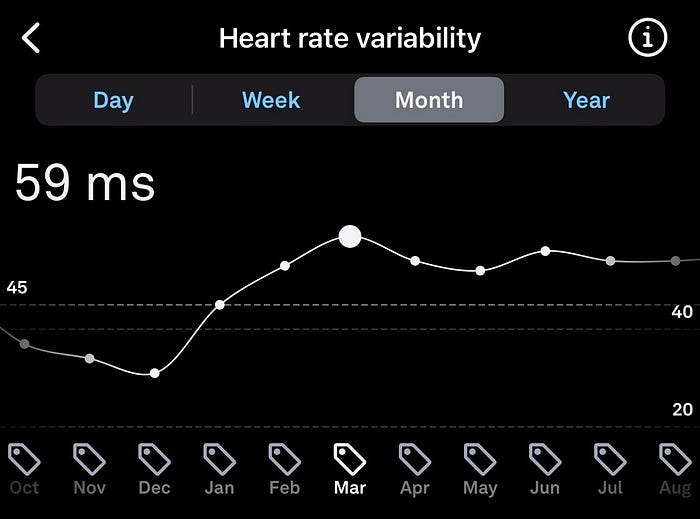


I'm a writer for Oura. Oura Rings track various physiological metrics like body temperature, respiratory rate, resting heart rate, and HRV. As part of my work, I've learned a lot about HRV.
I became aware that my HRV was relatively low (between 20 to 30). I'm a healthy, young, active person. I eat healthy (I'm a nutritionist!), I exercise regularly, and I sleep fairly well. I assumed my HRV would reflect this.
So I began reading paper after paper and interviewing some of the leading HRV experts trying to identify the most science-backed ways to increase your HRV. Here's what worked for me.
What is HRV?
HRV is a physiological measure that quantifies the variation in time intervals between heartbeats. It is primarily controlled by the autonomic nervous system (ANS), which regulates the balance between the sympathetic and parasympathetic branches.
The sympathetic branch is responsible for the "fight or flight" response, while the parasympathetic branch promotes "rest and digest" activities.
HRV is considered an essential indicator of ANS function and reflects the system's ability to adapt to internal and external stimuli, maintaining homeostasis.
Simply put: HRV shows how your body handles stress. When HRV is higher, it's an indication that your body is better at adapting to stress and staying balanced. But when HRV is lower, it suggests that your body might be struggling with stress and may be less healthy. In fact, it predicts mortality.
Is a low HRV dangerous?
High HRV indicates a healthy and flexible autonomic system, whereas low HRV is associated with:
A study found that a lower HRV had a 112% higher risk of all-cause mortality and cardiovascular events.
So in short: yes, a low HRV can be a point of concern.
However, it's a little bit more complicated than that.
HRV is a complex metric because it's unique to each individual, making it hard to compare with others at a population level, like you can with resting heart rate, for example.
You can only meaningfully compare your HRV to your own baseline. Additionally, HRV is regulated by the autonomic nervous system, and major deviations from an individual's baseline can be difficult to achieve due to physiological conditioning. Furthermore, the interpretation of HRV data requires a nuanced understanding of the individual's context and specific factors influencing their autonomic function.
Plus, it's a highly sensitive metric that is influenced by many factors from genetics and lifestyle, to your posture, hydration status, diet, and more.
That's why I was pleasantly surprised to double my HRV in less than two months.
How I doubled my HRV
Introducing: Low heart rate running
Protocol: 25–45-minute run at 50–60% of MHR 1–2x a week

I interviewed a neuroscientist who does a lot of work in HRV. He explained to me that most people have a low HRV because of chronic stress. But stress isn't just a psychological thing. Stress is also physiological. For instance, sleep deprivation is a physiological stressor. A tough workout is a physiological stressor.
I used to think that the harder my workout, the more effective it is.
This is partly true — high-intensity workouts can increase cardiorespiratory fitness, stamina, and strength. But they require more recovery. Intentional recovery. I was training four times a week at 90% or higher of my maximum heart rate (MHR).
The neuroscientist I interviewed explained that too many high-intensity workouts can keep your sympathetic nervous system constantly activated. You're persistently in fight or flight mode. This lowers your HRV.

Instead, learn to exercise in a parasympathetic state. This involves practicing deep breathing before and during exercise, to stabilize your heart rate. I've started running at up to 60% of my MHR, after doing five minutes of breathwork. I'm running slowly for 5 kilometers. My heart rate doesn't spike but remains fairly stable. I listen to relaxing music or a podcast to help keep my heart rate down.
After the run, I feel very relaxed and nicely energized. I do not feel a runner's high, but I don't feel activated either. The days after a run, my HRV increases.
And that's it. Literally, that's it.
It's a strategy well-supported by research and anecdotally — and the best part is that it's an extremely easy addition because it's not super high-intensity and thus taxing on the body.
Will this definitely work for you? Not necessarily. If you're currently sedentary or already do a lot of low-intensity exercise, it might be more effective to do more high-intensity exercise. That's what the research suggests anyway. But remember, you've still got to incorporate recovery.
Based on everything I've learned in the past year and a half working for Oura and interviewing some of the leading HRV experts, this is the best advice I could give for increasing HRV:
1. Lower your stress
High stress = low HRV, typically. Stress activates your sympathetic nervous system, causing this branch to dominate and resulting in a low HRV. The best way to manage stress? That depends on what you enjoy. For me, I like watching reality TV. That's something I've come to realize too, you don't have to do fancy stress-busting activities like holotropic breathwork or microdosing. You could simply just chill the fuck out, touch some grass, watch a comedy.
2. Exercise more overall
If you work in an office and/or are otherwise quite lazy, you've got to start adding in more movement throughout the day. The age-old "aim for 10,000 steps" is pretty unscientific in terms of evidence, but it's a good place to start. You don't have to get all your steps in at once — in fact, little and often seems to be the most effective for HRV.
3. Focus on high and medium
Structure an exercise routine that incorporates high and low-intensity exercise. For instance:
- 2 x 15-minute HIIT sessions 90–10% of MHR per week.
- 3 x 45 to 60-minute LISS cardio 50–60% of MHR.
Don't burn out on just one type; it's helpful to have variety in the intensity of your exercise. This is what trains your nervous system to become more adaptable.
4. Embrace hormetic stress
There's a reason everyone's obsessed with cold plunges right now. Hormetic stress involves exposure to low or moderate stressors that can improve and enhance your resilience to stress. For instance, a 2-minute cold plunge is objectively quite unenjoyable; it spikes your stress response and puts you in a sympathetic state. But once you're out, you get a surge of dopamine, and it instantly shifts you into a parasympathetic state, increasing your HRV.
The thing with hormetic stress that a lot of people get wrong is this: little and often. Hormetic stress is temporary, controlled, brief stress. If it lasts too long, it's just stress-inducing and demands recovery. Other types of hormetic stress include: HIIT, intermittent fasting, sauna, hypoxic breathwork, and even forms of mental stress like crossword puzzles.
5. Sleep, hydrate, eat.
The absolute basics. Sleep 7–9 hours a night. Drink 2–3 liters of water a day. Eat unprocessed, healthy food whenever you're hungry. After working as a health coach for a couple of years, I can safely say that this is the part where 90% of people are going wrong. If you haven't mastered the basics, your body will suffer, and thus your HRV will stay low.
I post health, fitness, self-improvement, and writing advice on here, and personal stories about motherhood + bizness on Substack. Pick your poison ❤