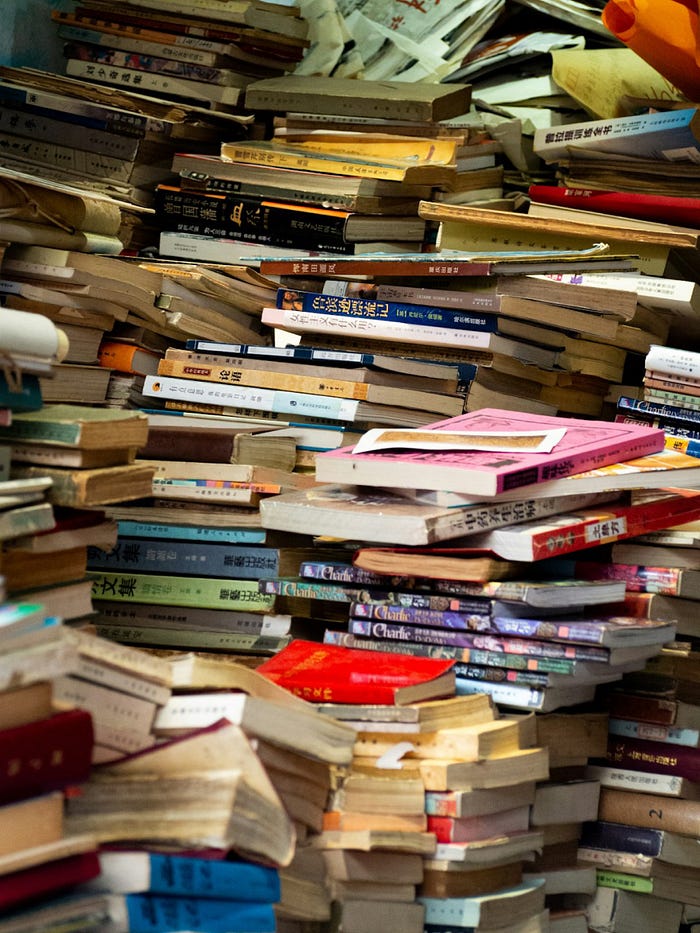

Do you have a habit of buying books that you never quite get around to reading? Turns out you are not alone. In fact, the Japanese have a word for it.
Tsundoku — the habit of acquiring books and then letting them pile up without reading them. It can also be used to describe the unread books that you have on your bookcase or stacked in a to-read pile next to your bed.
Although the word is Japanese it's not something that only affects Japanese people.
Actually, as an avid reader and book lover I have been acquiring books and letting them pile up for decades, I just didn't have a word for it until now. Looking around the house that I grew up in, it's fairly obvious that my parents were like this too — bookcases crammed full of books, surfaces filled with piles and piles of books that wouldn't fit into bookcases, and piles of new books appearing sporadically.
For me there's something comforting in learning that there is a word that perfectly covers this book collecting proclivity. 'Tsundoku.'
Where does the word Tsundoku come from?
Here's a breakdown:
- Tsun (積ん): Derived from the verb "tsumu" (積む), meaning "to pile up".
- Doku (読): Derived from "dokusho" (読書), meaning "reading".
- Tsundoku (積ん読): The combination of "piling up" and "reading," resulting in the act of buying books and letting them accumulate without reading them.
The term first originated as a Japanese slang term in the Meiji era (1868–1912).
The beautiful thing about it is that tsundoku is not really considered negative or shameful in Japan. Although some might see it as procrastination or as a mild form of hoarding, most people believe that they will read the books eventually. They find comfort and joy in the presence of the books — in the potential of all those words of wisdom sitting there waiting to be read.
We could say that book lovers can take comfort in their piles of emotional support books. In fact for book lovers the excitement of acquiring new books may even outweigh the excitement of reading them.
I do love the feel of a real physical book in my hands. I love new books with their shiny covers, their shiny pages and their shiny potential. And I love old books for their old pages, their history and their past. I even love the smell and feel of old books. But mostly I love them for their connection to the past — Where did they come from? Who held this book in their hands, and what did they learn from it?
However, as much as I love physical books, I recently started to see the need to declutter. There is only so much space that we can fill. Only so much clutter we can collect. There are only so many books that you can say yes to, and only so many piles of books that you can keep adding to or shifting around.
So for the last few years, I have avoided buying or adopting physical books and instead I've moved my obsession onto digital books. These days with the increase in kindles and ebooks I think the word tsundoku is just as likely to refer to the number of digital books piling up on your kindle waiting to be read.
I for one certainly have a habit of downloading ebooks when I come across them on sale, or when I first hear about them, and then I leave them on the kindle piling up and waiting for me to read them…you know waiting for that one day in the future when I have all that spare time to sit around and read the piles and piles of books that are just waiting to be read.
I do find reassurance in the fact that it is not just me who suffers from this 'tsundoku'.
Famous Tsundoku practitioners:
Nassim Nicholas Taleb first came up with the term 'anti library' in his book "The Black Swan". He used the term to describe the collection of unread books that many people own, emphasizing that this collection represents a powerful reminder of ones intellectual limitations and the vastness of what one doesn't know. The idea behind the antilibrary is that unread books are valuable because they represent potential knowledge and future learning opportunities.
Taleb's concept of the antilibrary builds upon the ideas of Umberto Eco, who used the term to describe a library as a research tool rather than just a display of knowledge.
"For Umberto Eco, a private library is a research tool. The goal of an antilibrary is not to collect books you have read so you can proudly display them on your shelf; instead, it is to curate a highly personal collection of resources around themes you are curious about."
While both Tsundoku and antilibrary are to do with collecting books, the focus is different.
In essence, both concepts deal with unread books, but the antilibrary is more of a philosophical perspective on the value of intellectual curiosity and the vastness of knowledge, and tsundoku is essentially focused on the acquisition of books.
"Collect books, even if you don't plan on reading them right away. Filmmaker John Waters has said, "Nothing is more important than an unread library."
― Austin Kleon, Steal Like an Artist: 10 Things Nobody Told You About Being Creative
However, it isn't just about collecting books. Tsundoku implies hope, curiosity and ambition. Even if the books remain unread, they can still shape our environment, our mood or our identity.
Taking Tsundoku further: Is Tsundoku only for books?
While "tsundoku" was originally coined for books, these days the concept of tsundoku may be applied to other things. In fact, I believe that it could be used for anything that is acquired with the intention of using or enjoying it later, but which then accumulate without being used. For many people this may be items like video games, movies, or even clothing.
For me, other than books, there are two things I do that I think might fall into the Tsundoku category.
The first is courses — I love browsing courses, and finding new ones on the internet, or on Udemy. There are so many different things that I want to learn. When I find one that seems interesting or when there is a sale on courses, I feel compelled to buy one even if I have no intention of doing it straight away. Collecting courses that I aspire to do, but don't quite get around to starting. These courses are often on a vast range of topics — looking at my to-start list on Udemy, at the moment I have courses in Qigong, nutrition, writing fantasy, YouTube algorithms and several drawing courses all there waiting for me to start. I really should get going with them.
The second is that I may have a small problem with buying art and craft projects. Paints, sketchbooks, funky buttons to make something cool with, crochet kits, sewing kits, mosaic kits, embroidery kits, canvases, even screenshots of interesting Pinterest projects. I'll see them somewhere, believe in the potential of them, buy them, and then there they will sit, piling up until that one day in the future when they will move off my tsundoku pile and into my pile of finished crafts.
I like to think of my books, my courses and my art supplies as my emotional support. There they sit, full of potential and possibility, patiently waiting for me to be ready to use them. And you know what? One day maybe I actually will.
"Even when reading is impossible, the presence of books acquired produces such an ecstasy that the buying of more books than one can read is nothing less than the soul reaching towards infinity… We cherish books even if unread, their mere presence exudes comfort, their ready access reassurance."
― A. Edward Newton, The Amenities of Book Collecting And Kindred Affections