

The Friction Point in Modern Reconnaissance
In the domain of bug bounty hunting and red teaming, reconnaissance is the bedrock of a successful engagement. The axiom "the more you know, the more you own" holds universally true. However, the practical reality of modern External Attack Surface Management (EASM) is often a fragmented, high-friction process.
A researcher typically juggles a constellation of disparate, single-purpose tools: one for passive DNS enumeration, another for certificate parsing, a third for historical archive mining, and yet another for live service validation and visual inspection. This constant context-switching — piping output from tool A to tool B, managing intermediate files, and manually handling dependencies — introduces significant latency into the "Time-to-Insight" (TTI) metric.
I identified this workflow inefficiency as a critical bottleneck and set out to engineer a solution that would streamline the entire reconnaissance lifecycle into a unified, automated pipeline.
Introducing ZeroRecon: A Unified EASM Framework
My objective was to construct a tool that could take a target domain and, with zero manual intervention, execute a comprehensive reconnaissance methodology, delivering actionable intelligence ready for vulnerability analysis.
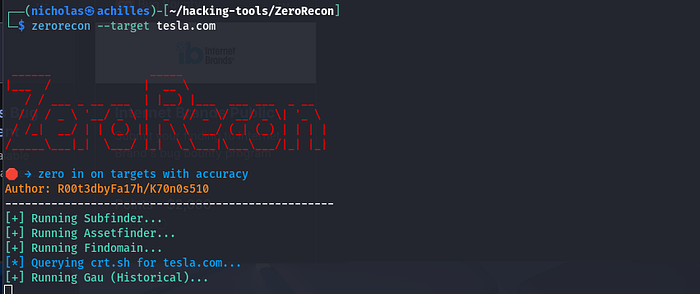
The result is ZeroRecon, a Python-based orchestration framework that intelligently chains industry-leading tools to maximize attack surface coverage while minimizing operator overhead. The guiding philosophy is encoded in its slogan: Zero in on targets with accuracy.
You can view the project repository here: R00t3dbyFa17h/hacking-tools

Architectural Overview
ZeroRecon is engineered as a multi-stage modular pipeline. I eschewed a simple Bash script in favor of Python to leverage more robust error handling, structured data processing, and platform independence.
Rather than bloating the tool with disparate clients for every data source, ZeroRecon leverages aggregation engines like Gau. This allows us to query the AlienVault Open Threat Exchange (OTX) API without needing to manage individual API keys or rate limits manually. It's about efficiency: getting the same data with less friction.
The architecture executes four distinct heuristic phases:

Phase 1: Aggressive Multi-Source Enumeration
To ensure maximum coverage, ZeroRecon doesn't rely on a single data source. It orchestrates a parallel execution of diverse enumeration techniques:
- Passive DNS Aggregation: Leveraging
Subfinderto query dozens of passive DNS sources (e.g., Shodan, Censys) without touching the target infrastructure. - Certificate Transparency Analysis: Performing direct queries against the
crt.shlogs to identify subdomains via SSL/TLS certificate history. - High-Speed Heuristics: Utilizing Rust-based
Findomainand Go-basedAssetfinderfor rapid, robust discovery.

Phase 2: Deep Archival Mining
Traditional DNS enumeration often misses transient or deprecated assets. I integrated Gau (Get All URLs) to mine the Wayback Machine and AlienVault OTX. This phase uncovers "forgotten" subdomains—often development or staging environments that no longer have public DNS records but remain vulnerable.

Phase 3: Live Service Validation & Fingerprinting
A list of 10,000 subdomains is useless if 9,900 are dead. ZeroRecon pipes the raw attack surface through Httpx, a highly concurrent HTTP probing engine. This filters out dead DNS records, handles complex redirect chains, and performs initial technology fingerprinting (e.g., identifying web server software and status codes).

Phase 4: Automated Visual Reconnaissance
The final output is designed for rapid human consumption. The verified, live endpoints are passed to Aquatone, which utilizes headless browser technology to capture screenshots of every running web application. This allows a researcher to visually scan hundreds of assets in minutes, quickly identifying high-value targets like admin panels or default pages.
Solving "Dependency Hell" with Automated Provisioning
A powerful tool is useless if it is difficult to deploy. A primary engineering challenge was managing the diverse dependencies — a mix of Python libraries, Go binaries, and Rust executables.
To solve this "dependency hell" for end-users, I developed a robust install_dependencies.sh bootstrap script. This script automates the entire provisioning process on Debian-based systems (like Kali Linux). It handles everything from installing the Go language runtime and configuring $PATH variables to downloading pre-compiled binaries for tools like Aquatone that lack standard package managers.
This turns a complex, multi-hour manual setup into a single command:
sudo ./install_dependencies.sh
Conclusion
ZeroRecon is more than just a script; it is an opinionated framework for modern reconnaissance. By automating the low-level, repetitive tasks of data gathering and validation, it frees the researcher to focus on what truly matters: creative vulnerability analysis and exploitation. It is a powerful new capability added to my offensive security toolbelt, and I am proud to open-source it to the community.
A Builder's Note There is a profound satisfaction in building a tool with your own hands — taking a problem, architecting a solution, and watching it come to life in the terminal. As I developed ZeroRecon, I was reminded of Proverbs 24:3–4: "By wisdom a house is built, and by understanding it is established; by knowledge the rooms are filled with all precious and pleasant riches."
In the world of cybersecurity, this principle holds true. You cannot secure (build) a network without understanding its architecture, and you cannot defend it without the "knowledge" of where its vulnerabilities lie. ZeroRecon was built to automate that gathering of knowledge. It is the digital "understanding" that establishes the foundation, ensuring that when we finally move to secure the "house," we aren't leaving any doors unlocked or windows unlatched.
CONTACT INFO
- Discord= HTB/CTF Study Server
- Linkedin=www.linkedin.com/in/nick-mullenski-9a5980367
- HTB-CTF-Team=Kr0nos510