

We look at trends to find the baseline trajectory of current developments into the future. But trends are often not so straightforward. Yes, advancements of bioengineering are steadfast, but the ethical dilemmas of tinkering with human nature have stirred up a long-lasting debate. The empowerment of women is an increasingly sensitive issue, but some suggest that the gender pay gap is driven by evolutionary differences that are likely not going away soon.
The same could be said for visions of the future, which, like trends, are an equally powerful force affecting change. Visions ˗ collective, organizational and individual alike ˗ are counterbalanced by barriers and obstacles. The rise of veganism is fought by celebrity chefs , who promote fine dining cuisine irrespective of the origin of ingredients. A new machinery might be available to optimize a manufacturer's product line, but the owner is still living under the shadow of huge sunk costs that stray him away from investing further. An engineer, inspired by the prospect of the technological singularity, researches brain-machine interfaces, but is discouraged by research retrenchment measures during an economic recession, or by an ideology strongly against trans-humanism in her proximal social environment.
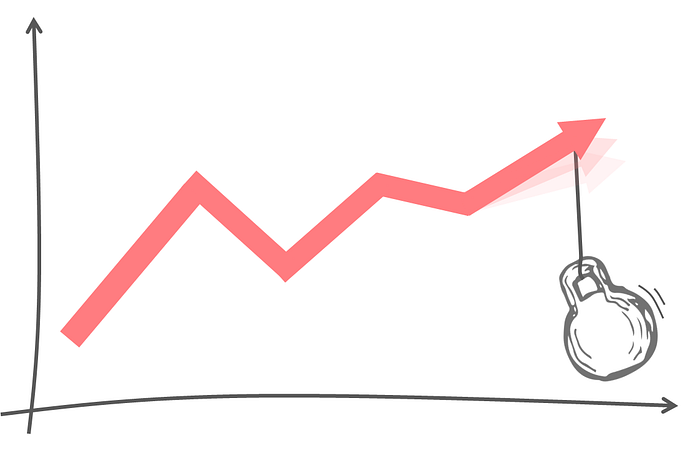
All driving forces, trends and visions alike, have a weight, literally. They are not unidirectional forces, their direction into the future is contested. That is why, when we analyze driving forces, the futures triangle is so powerful. The futures triangle [1] is a foresight mapping tool that allows us to take into account not only the primary directions of trends and visions moving us towards the future, but also the counter-forces of the past, the barriers to change. These three dimensions, visions, trends, and barriers/obstacles, are represented by the three angles of the triangle: pulls of the future, pushes of the presents, and weights of the past, respectively, as in the figure below, where the three forces interact, figuratively in the middle of the triangle, to create different possible futures:
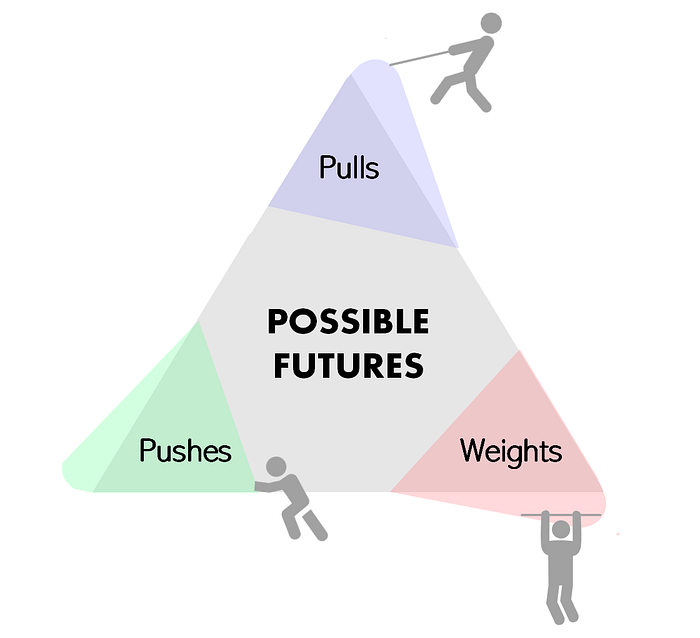
When we do foresight, we start by mapping the driving forces of change. If we do this with the futures triangle, we make sure to capture these three dimensions. The futures triangle is therefore superior to traditional trend analysis, e.g. using frameworks like PESTEL, STEEP, STEBNPDILE, etc., because it takes into account the important tensions between pushes and pulls on one hand, and weights on the other hand, not just the topics represented by the letters of such acronyms (social, economic, environmental, technological, etc.) which can in fact be easily integrated into the triangle. The futures triangle is superior because it analyzes what we can call the contest for the future.
But mapping forces of change is just the starting point of foresight practice. The next step is creating future scenarios. Then, how do we make sure that the insightful and valuable contest for the future represented in the triangle is retained in our scenarios, so that these will be plausible and realistic narratives? Indeed, a scenario of the future of the medical profession, for instance, will sound more interesting and real if it unpacks the conflict between doctor's vested interests in and reactions to automatic diagnosis apps, rather than offhandedly stating that 30% of doctors are sacked due to automation.
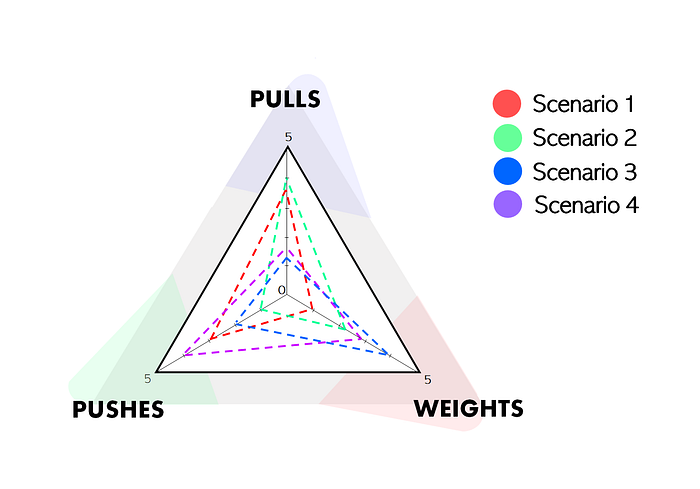
There is a way to do that. That's where futures triangle 2.0 comes in handy. This variation of the traditional futures triangle method allows us to deliberately engage in a discussion on whether the contest for the future is retained in scenario narratives. This is done with the avail of the futures triangle 2.0 figure below:
The whole process involves 4 easy steps:
- First, the three dimensions affecting the future, that is, pushes, pulls, and weights, are mapped using the traditional futures triangle method. In the example of the futures of the medical profession, we would probably identify automation as a push, the resistance to it as a weight, and the idea of doctors morphing into nanomedicine technicians as a vision.
- Then, we create scenario narratives with a foresight method of choice, e.g. 2X2, 4 generic futures, Shell, etc.
- Next, we rank each scenario, on a scale from 0 to 5, according to the degree to which it is dominant in the pushes, pulls, and weights dimensions of the futures triangle (0 = not dominant at all, 5 = completely dominant), and fill the futures triangle 2.0 figure with the resulting scores. This allows us to track each scenario's configuration of the three measures and compare them to one another in a single figure. This process works at best in a team of foresight practitioners/scenario planners. Each individual will score each scenario against the three dimensions independently. The 3 scores will then be averaged, decreasing bias.
- Finally is iteration. If the configurations are not diverse enough, which is clear when lines of different colors are close or even coinciding in the futures triangle 2.0 figure, then the scenario narratives need to be changed. The narratives are tweaked and the figure is redrawn until the scenarios' configurations are different enough. This iterative process encourages, even forces us, to deliberately integrate the contest for the future into our scenario narratives.
To know more about the futures triangle 2.0 method, you can read the full research paper. You can also watch a video abstract of the paper.
To see articles like this more often, you can support Alex's videos/articles here: https://www.patreon.com/alexfergnani?fan_landing=true
References & Notes
[1] Inayatullah, S. (2008). Six Pillars: Futures Thinking for Transforming. Foresight, 10(1): 4–21.
[2]Fergnani, A. (2020). Futures triangle 2.0: integrating the Futures Triangle with Scenario Planning. Foresight, 22(2): 178–188.
CREDITS FOR ICONS (The Noun Project): Tyler Glaude, Alex Muravev, Adrien Coquet, Pavel N.