

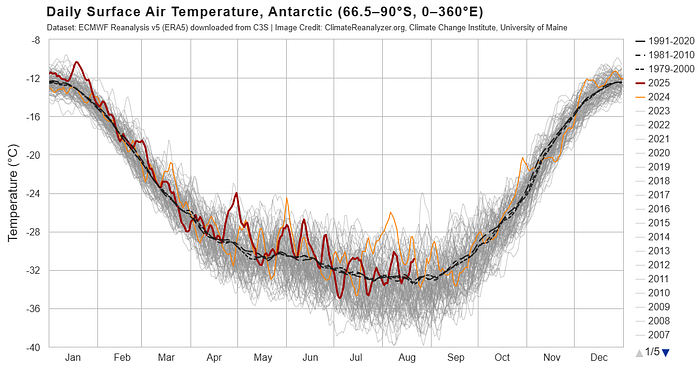
March 2022. East Antarctica — the coldest place on Earth — stops behaving like the coldest place on Earth. Temperatures rocket 39°C (70°F) above normal in just three days, turning a lethal −54°C into an almost comforting −15°C. Inside Concordia Station, where life usually means frostbitten eyelashes and clumsy hands in bulky gloves, scientists strip down to shorts and t-shirts, stunned by the most extreme heat wave ever measured on the planet.
And then, in the same week, the impossible happens.
Warm rain falls where only blizzards should. Within hours, the Conger Ice Shelf — a slab of ice the size of Rome — collapses into the ocean, like a city erased overnight. The kind of geologic event that once took centuries now unfolds in days.
2023: Antarctic infinity, for once, seems to find a breaking point.
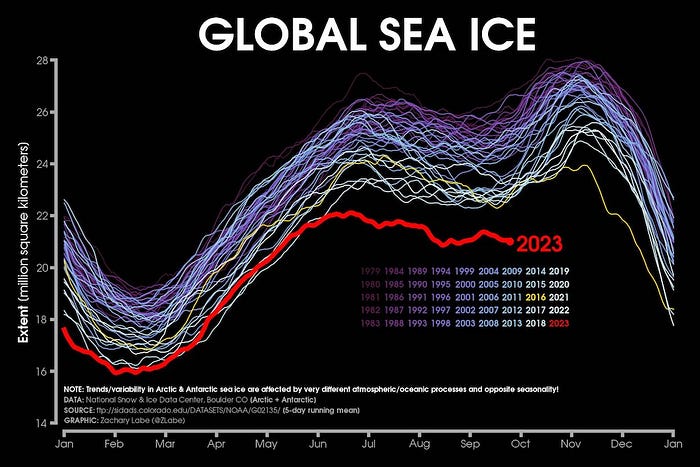
After bottoming out at a record-low summer extent in February — 10% lower than the already disastrous 2022 — Antarctic sea ice keeps falling for six straight months. By July, when the sea ice should be near its winter maximum, 15% is gone — an area larger than my country, Argentina. By September, the ice hits its lowest maximum ever recorded, shattering the previous record by more than double. Scientists call it a "five-sigma event": something so rare it should only occur once every 10,000 years. Maybe once in several million. Like walking into the ER with a body temperature of 46°C (115°F) — doctors wouldn't believe you were alive.
July 30, 2024. It happens again — this time, in mid-winter.
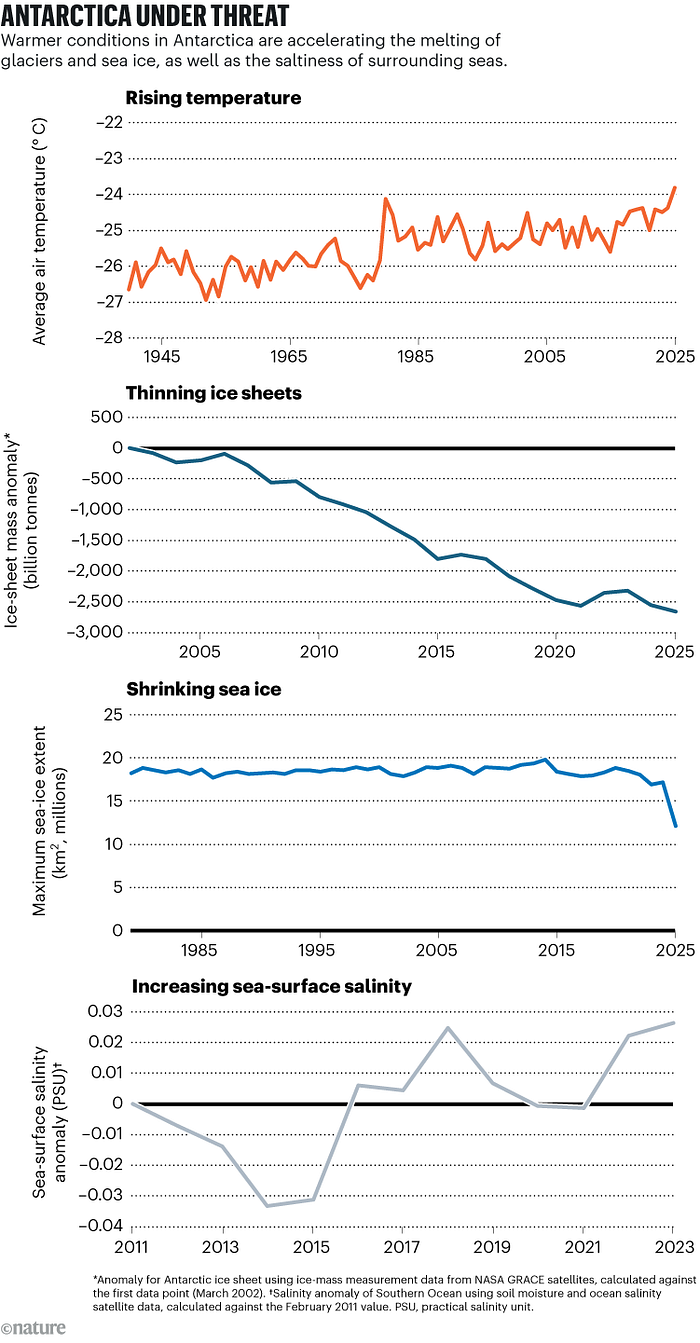
East Antarctica's ground temperatures surge 28°C (over 50°F) above normal. The South Pole logs its warmest July in decades, 6.2°C (11°F) above normal. Ten days of temperatures that look more like summer than deep winter — the frozen world rewired.
By 2025, the pattern has hardened.
Sea ice extent plunges yet again, tying with 2022 and 2024 for the second-lowest in history, missing an area larger than Pakistan.
The Antarctic logbook from recent years reads more like an obituary than a journal. This ice has not come back. It may never come back. And here's what most miss: change is easy to understand when it's linear, like a child growing taller year after year. But collapse doesn't happen in straight lines. It happens like an explosion.
The atomic bomb over Hiroshima. The first exponential spike of COVID-19. Change that seems manageable — until suddenly it isn't. That's how the Great Un-Freezing now looks: not a metaphor anymore but exponential heat, exponential ice loss, exponential consequences leading to the most significant global environmental change of the decade.
There is a wall of heat pressing at the door in the Southern Ocean, and that door is starting to cave in. These Antarctic-wide shifts, their new volatility, and their persistence point toward an abrupt, non-linear transition.
Yes, scientists need more data to confirm if this is the beginning of a fundamental shift. But the signals already flashing are ominous.
And new evidence just keeps surfacing.
Every Piece We Lose Weakens The Next
Break one piece of a system this vast, and you don't just lose that piece — you set off a chain reaction. Antarctica is no exception. Shifts here don't stay local; they ripple outward, multiplying like falling dominoes with consequences that reach every coastline on Earth. What makes it more dangerous is that Antarctica's tipping points are less understood than its counterpart in the Arctic. But the evidence is mounting: abrupt, cascading, sometimes self-perpetuating changes are already underway.
One of the many triggers is floating sea ice — the thin seasonal shield that forms in winter. In 2014, Antarctic sea ice hit a record peak of 20.11 million square kilometers (7.76 million square miles). Since then, it hasn't just slipped; it has collapsed inward, shrinking 120 kilometers (75 miles) closer to shore (a round trip in the Channel Tunnel connecting England and France). In winter — when the ice should be at its strongest — coverage has been declining 4.4 times faster around Antarctica than in the Arctic.
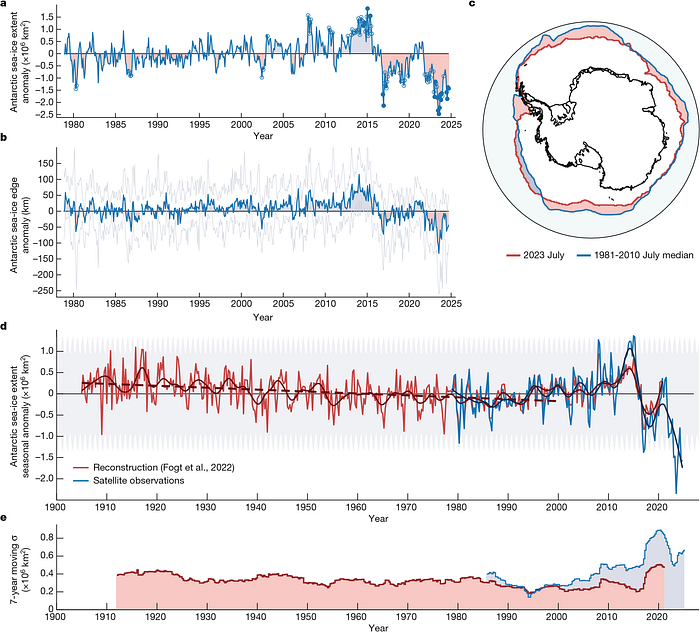
Put bluntly, in just a decade, Antarctica has lost as much winter sea ice as the Arctic has shed in nearly half a century. And that's where the feedback loop kicks in.
The Arctic is already warming four times faster than the rest of the world because of one simple fact: white reflects, dark absorbs. Sea ice works like a planetary mirror, bouncing sunlight back into space. Strip it away, and the ocean below turns into a heat sponge, pulling in the sun's energy. Less ice means more heat, more heat means less ice, and the spiral feeds on itself.
Now that spiral grips the Southern Hemisphere — only here, the consequences could be bigger. And irreversible. Unlike the Arctic, where models suggest that stabilizing global temperatures could stabilize sea ice, Antarctica doesn't play by the same rules. Even in climate simulations where the planet cools, Antarctic sea ice keeps shrinking. The Southern Ocean is swallowing excess heat and refusing to let go.
And that could bring major consequences.
Antarctica's colossal ice cap is held in place by ice shelves — the floating extensions of land ice — and sea ice itself, which shields shelves from waves and warmer currents. Take away the sea ice, and the water attacking those shelves gets warmer and rougher. Studies show that warm water carves cavities beneath the shelves, letting in even more heat, speeding up their collapse.
Lose the shelves, and you lose the brakes. The ice sheets behind them, surging into the sea, could crank up sea level rise in abrupt shifts and rewrite our timelines for coastal flooding not in centuries, but in decades.
And it's not just ice that suffers. The disappearing sea ice is also tearing into life itself. Krill — the tiny shrimp-like creatures that feed penguins, whales, and seals — are already declining as seas acidify. With less sea ice, breeding seasons break down, food chains falter, and penguin chicks hurl themselves off cliffs in a desperate bid for survival.
Sea ice props up shelves, shelves protect sheets, sheets lock up sea levels, and all of it sustains life in the Southern Ocean. Every piece we lose weakens the next.
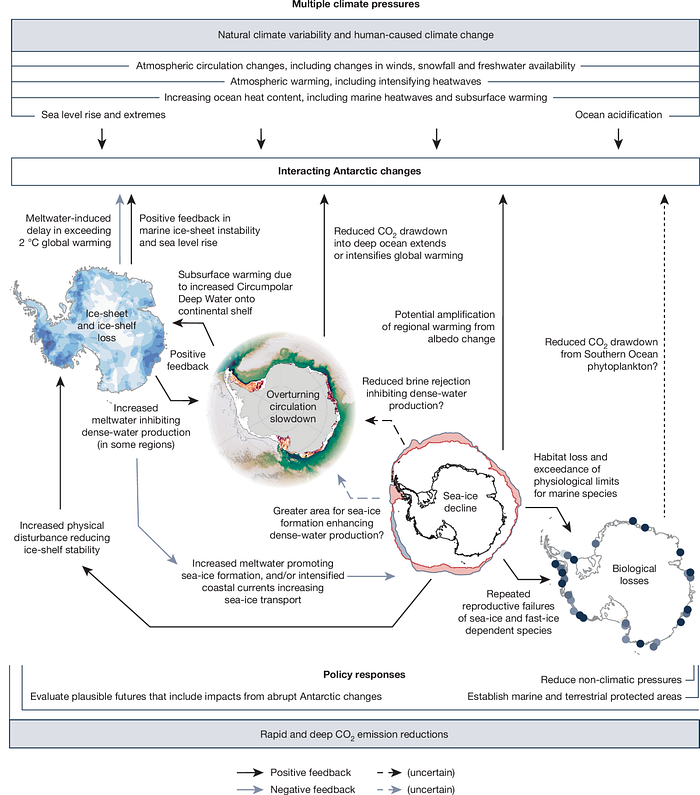
And Antarctica — that endless white fortress we once thought unshakable — is quietly losing them all.
The White Kingdom Is Cracking
You've probably never heard of the Antarctic Circumpolar Current (ACC). That's not an accident. We scroll endlessly through numbing content, yet the most powerful current on Earth barely makes the news. But while we've been busy watching billionaires bicker and the latest fashion trends, the ACC has been doing the work of keeping this planet habitable.
Spinning like a cold, unbroken artery around the bottom of the world, the ACC shoves 182 million cubic meters of water per second through the Southern Ocean. That's five Gulf Streams. One hundred Amazon Rivers. A force so vast it welds the Pacific, Atlantic, and Indian Oceans into one single planetary bloodstream — the ocean conveyor belt. It carries heat, carbon, nutrients, and the very conditions that make life possible.
The oceans already swallow more than 90% of the heat from our greenhouse gas binge. The Southern Ocean alone soaks up three-quarters of that heat and nearly half of the carbon dioxide we emit. For decades, the ACC has been the Antarctic's castle moat — fending off warm waters, blocking invaders clinging to floating debris, and preserving what may be the planet's last great shield against climate chaos. Without it, we'd already be cooked alive.
By now, I guess you already suspect it: that protection is cracking.
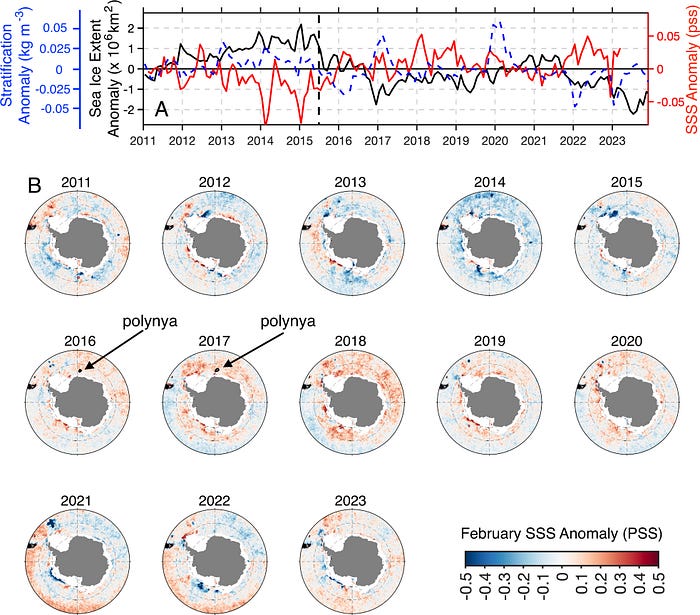
Here's how it works — or at least how it used to. When Antarctic waters freeze in winter, the ice expels salt, making the water beneath denser, heavier, and able to sink. That sinking motion powers the thermohaline cycle, the ocean conveyor belt that cycles heat and nutrients around the globe like a climate engine. But the engine is stalling. The flood of meltwater from shrinking sea ice and glaciers is freshening the surface, diluting its salt and making it too light to sink. A cycle that once took 1,600 years to churn is now buckling under the weight of human warming.
Research shows the Antarctic overturning could weaken by 20% as soon as 2050 — even faster than the Hollywood star Atlantic Meridional Overturning Circulation. That slowdown would supercharge ice loss, fueling sea-level rise, and may be a prelude to catastrophic collapse.
The stakes are endless as thresholds are crossed. The ultimate strike could crush the architecture of our world — one that today looks more like a house of cards than a medieval castle. If global heating pushes us to 2 °C, the West Antarctic Ice Sheet could collapse, kicking loose 5.3 meters (17.4 feet) of sea-level rise. Even the supposedly stable East Antarctic Ice Sheet is now showing cracks. From 2000 to 2023 alone, seas climbed 7.6 centimeters — a third of that from Greenland and Antarctica. If the whole Antarctic ice storehouse goes, it's 57 meters (187 feet). Every coastal city on Earth, gone.
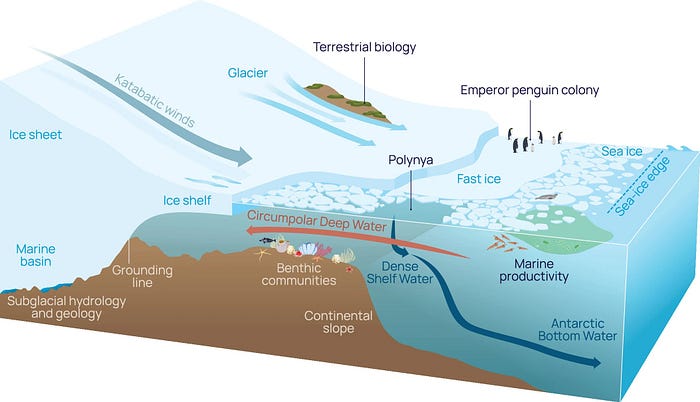
Multiple fronts are at their breaking point. They might seem remote in the White Kingdom of Far, Far Away. But one way or the other, these distant changes will eventually flow right to our front doors.
A Choice Between Collapse and Courage
If the odds of a plane crash were as high as the risk of the Antarctic Circumpolar Current stalling and triggering an Atlantic circulation collapse, we'd ground every flight immediately. No questions asked. Yet when scientists warn that the only ride we've got — Earth itself — could veer into a nosedive, we just tighten our belts and ask for popcorn.
That's the delusion we live inside: being warned about a house fire but deciding to finish a Netflix episode first.
Still greenlighting offshore oil. Still letting children sketch penguins in science class as if Antarctica were a fairy-tale ice kingdom instead of a continent bleeding out at its edges. Still treating the breakdown of our life-support system like diabetes: uncomfortable, but manageable with a solar panel here, a carbon credit there, and a fancy EV in the driveway.
But this isn't diabetes. It's cancer. The kind that spreads quietly until one day it becomes terminal.
The Maud Rise polynya — a hole in the sea ice the size of Austria — has returned after 40 years. The Southern Ocean is buckling under heat, salinity shifts, and collapsing currents. Every pressure point is being hit, hard, fast, and all at once.
We don't know for certain how close the cliff edge is. But we only know what lies below: slowed currents, rising seas, collapsing ecosystems, drowned cities. The mirror that once bounced sunlight is dissolving into an abyss of feedback loops with salt in their teeth.
Today, keeping global warming to 1.5°C is like chasing a mirage — we can see it, but it's slipping away. Instead of dreaming about perfect solutions, we're facing a future where we need to both reduce damage and prepare for unavoidable changes. We comfort ourselves with the idea that some last-minute savior — be it new technology, human creativity, a cordyceps mushroom, whatever — will rescue us from climate chaos. But we won't always be as lucky as this penguin.
Sometimes, there's no dramatic last-second escape. And that leaves us with a choice: collapse, or courage to do what it takes and kill the illusion of eternal growth and overconsumption that is both devouring and burning this planet.
Because, even if we don't see it from our shores, the fight for Antarctica is the fight for life itself. And like every real fight, it demands more than optimism. It demands bravery.
So be loud.
Thank you for your thorough reading and support! Subscribe for immediate insights and join the 1,600+ Antarctic Sapiens community for weekly content.