


Donald Trump captured global attention in August 2019 by making an offer for the United States to buy Greenland from Denmark.¹ The Danish and Greenlandic governments both dismissed the idea as absurd, pouring icy water on Trump's media storm.
Vague and short-lived, Trump's 'Greenland thing' seemed a microcosm of the scatter-gun approach that he brought to policy-making — silly, weird, unprecedented, pointless, transient.
Its comic value notwithstanding, Trump's effort to purchase Greenland actually represents one of the most historically significant episodes in the Trump administration's hectic single term. As climate change continues to transform the Arctic, revealing untapped natural resources and opening up new sea lanes, America's long-standing interest in acquiring Greenland is set to increase exponentially, even while the inhabitants of the island inch closer to full independence. Trump was not the first to raise the idea, and he certainly will not be the last.
Aside from its economic potential, the forty-fifth president saw Greenland as a valuable strategic asset for the United States in its effort to retain sole superpower status in global politics.
As for what would happen to the Greenlanders themselves, however, little was said. 'A lot of things could be done,' Trump noted dimly, 'essentially it is a large real estate deal.'² He then posted a sarcastic Tweet in which he shared an image of a small Greenlandic village with a Trump skyscraper superimposed in the middle, and the text: 'I promise not to do this to Greenland!'³
The twin promise to develop Greenland economically while protecting its identity from external interference (in the form of a tower) was unknowingly reminiscent of Denmark's own programme to modernise the island in the twentieth century. Here was another Western power with little knowledge of conditions in the Arctic promising to make things better.
Then again, of course, the lives of the 57,000 Greenlanders, most of whom are Inuit whose ancestors crossed from Canada to Greenland 1,100 years ago, are of little concern to US policymakers. Their real objective is the exploitation of Greenland's untapped resources. Greenlanders are just an inconvenient diplomatic obstacle to be placated or pushed aside.
This article examines the history of colonial exploitation and modernisation in Greenland, and considers how new opportunities for exploitation created by climate change have brought the island firmly back onto the American agenda.
When viewed in this broader context, it becomes clear that Trump's proposal was indicative of a profound and long-term shift in global security priorities — even if he lacked the linguistic aptitude to express it as such. We should not be surprised to hear future presidents try to articulate a more diplomatically sensitive version of the same idea.
Exploitation
They have no treasures … to allure the hands of robbers, and have consequently to fear no wars, violence, or oppression. - David Crantz, Christian missionary, on the Greenlanders, 1765.⁴
The first European colony on Greenland was established by Norse settlers around 985 AD. Greenland, to the medieval Europeans, was a promising but not abundant land at the very edge of the known world. The Icelandic sagas record that Eirik the Red, a Norse explorer and settler, called it 'Greenland' because 'he said people would be attracted there if it had a favourable name.'⁵
While this is sometimes considered a mischievous joke, 'Greenland' was not an inaccurate description of the western and southern shores during summer.⁶ Still, Greenland's resources — fish, seals, whales, reindeer, foxes, driftwood, and its limited arable land — were never able to support more than a few thousand Norsemen at any one time.⁷
Mainland Europe lost regular contact with the Norse Greenlanders in 1410. Successive Danish kings tried to re-establish contact, but when they finally did resettle Greenland in 1721, the Norse were nowhere to be found. Greenlandic oral tradition interpreted by the new European settlers suggests they were wiped out in violent conflict with the Inuit, but this theory is not generally supported by the archaeological community.⁸
Whatever happened to the Norse Greenlanders, the new Danish arrivals in the eighteenth century succeeded in violently pacifying the Inuit, but found it difficult to profit from their ownership of the island due to a lack of fuel and other natural resources.⁹ These limitations did not stop them from trying.
The Royal Greenland Trade company maintained a monopoly over shipping to and from Greenland from 1776 to 1950, drawing significant profits from quarrying the island's cryolite; an important material used in America's heavy industry boom. In 'exchange,' if it can be called that, the Inuit received imported goods based on what the Royal Greenland company felt they needed.¹⁰
The Inuit people themselves were also a 'resource' to the Europeans, frequently captured and taken back to Europe to be exhibited.¹¹ They carried emotional value for the Danish people, who enjoyed seeing themselves as parental figures to these 'noble savages,' with a duty to protect their way of life from the crushing pressures of global competition.¹²
As the Danish realm shrank in the twentieth century, Greenland became more symbolically important as the last embodiment of Danish colonial power.¹³
Today, with climate change making it easier to extract the oil and gas reserves lying beneath the ice, Danish companies, supported by the government, have been first in line to extract them, with little of the profit going to the Greenlanders.¹⁴ While Denmark profits, some Greenlandic communities are at risk of seeing their way of life obliterated by rising temperatures.¹⁵ Centuries of exploitation are coming to a head.
Modernisation
Stone age and jet age have met. The old has not yet disappeared; the new not fully come. - English author Eve Garnett on the colonisation of Greenland, 1968.¹⁶
There is a long history of Europeans and Americans trying to coerce the Inuit to conform to their 'civilised' way of life. In 1721, the Norwegian Lutheran missionary Hans Egede set out to find the 'lost' Norse settlements in Greenland, assuming that they were still Catholic and in need of enlightenment. He found no Europeans, but instead spent decades converting the native Inuit.¹⁷
Despite their patience in humouring Egede's wish to be shown around the ruins of the Norse settlements, the conversion of the Inuit was frequently violent. Inuit spiritual leaders — known as Angakkuq, plural Angakkuit — were naturally suspicious of these strange missionaries challenging their beliefs, but their concerns met with an iron fist.
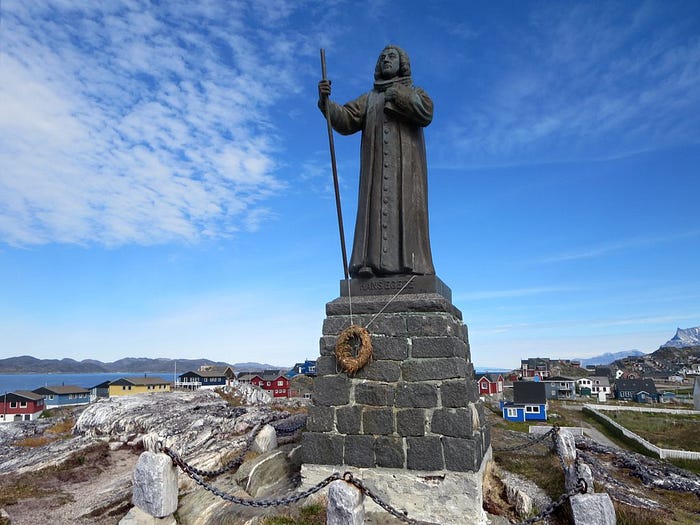
One Angakkuq who tried to make the Europeans leave was threatened with a gun. Egede's biographer wrote that the Inuit had come to fear 'the terrifying power of the white man's hunting weapons and rumours that they were not always confined to the slaughter of birds and animals.' Later, Egede organised a band of settlers to administer a beating to the Angakkuq in question. He was threatened with death should he offend again.¹⁸
David Crantz, a missionary who traveled to Greenland in 1759, also reserved nothing but scorn for the 'ridiculous superstitions' of Inuit religion,¹⁹ and recorded another instance of an Inuit person being 'severely beaten' for his resistance to Christianity.²⁰ Refusing to be 'saved' was not an option.
The Danish missionaries built settlements from which they could direct their efforts to 'civilise' Greenland's 'greasy inhabitants'.²¹ Sometimes their presence alone was enough to cause suffering. They brought diseases like smallpox from Europe, which Hans Egede estimated to have killed two or three thousand Inuit (out of around twelve thousand total) in a single outbreak in the 1730s.²²
The Europeans also introduced firearms to Greenland, which drastically upset the fragile balance of resources on the island. By the early twentieth century, reindeer populations in some parts of Greenland had been wiped out due to over-hunting.²³
In the 1920s, the Danish authorities started encouraging the Inuit to keep sheep as an alternative to migratory hunting lifestyles, but the climate was not well-suited for such activity. In 1966–7, 60% of the sheep died due to frost and snow.²⁴
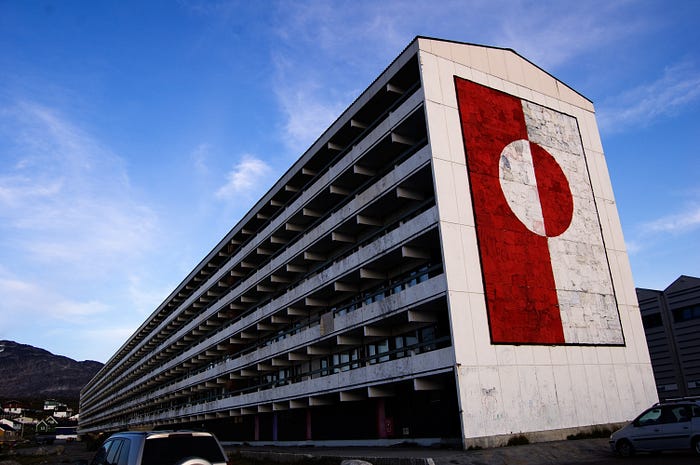
Another poorly-judged modernisation project was the building of Blok P, an enormous residential complex in the capital city, Nuuk, erected by the Danish authorities in 1965–6. Built on the European model of low-cost tower blocks and housing around 1% of Greenland's entire population, Blok P's doorways were too narrow to accommodate Inuit winter clothing, and because it did not provide anywhere to carve up fish, some residents used their bathtubs for this purpose and clogged the drains with blood. Lack of storage space for fishing gear, meanwhile, resulted in fire exits being obstructed.²⁵
When built, Blok P was the largest residential complex in the Danish realm²⁶ — a colossal repudiation of the absurdly arrogant belief that Europeans, in their temperate climate, knew best how to 'modernise' the Arctic.
Blok P was knocked down in 2012, but the condescending metropolitan attitude it represented found a powerful new advocate in 2019 — Donald Trump.
Donald the Orange
There was once a very obstinate man. No one in the world was as obstinate as him. He always had to have his own way in everything. The only person who dared oppose him was his wife. - 'The Man in the Moon,' a Greenland Inuit folk tale.²⁷
Eirik the Red discovered Greenland for the Europeans; Donald the Orange rediscovered it for American foreign policy wonks.
When Donald Trump suggested buying Greenland from Denmark in August 2019, many commentators were understandably amused; here was another crazy Trump policy in a long line of crazy policies.
However, while it is easy to dismiss anything Trump says as a joke, his Greenland policy was both historically precedented and indicative of future geopolitics in a rapidly changing climate. We should take it seriously — the idea has lasted for over 150 years and will not simply go away when Trump leaves office.
The first suggestions for the purchase of Greenland came in the mid-nineteenth century. In the wake of America's acquisition of Alaska from Russia in 1867, Democratic politician Robert J. Walker suggested also buying Greenland as part of his plan to surround and eventually acquire Canada.²⁸
The idea was again advocated during the Second World War by the Council on Foreign Relations, a foreign policy think-tank, at a time when some feared that Nazi Germany could use Greenland as a stepping stone for an invasion of America.²⁹
After the war, Harry Truman became the first president to make a concrete proposal when he offered Denmark $100m for the island in 1946.³⁰
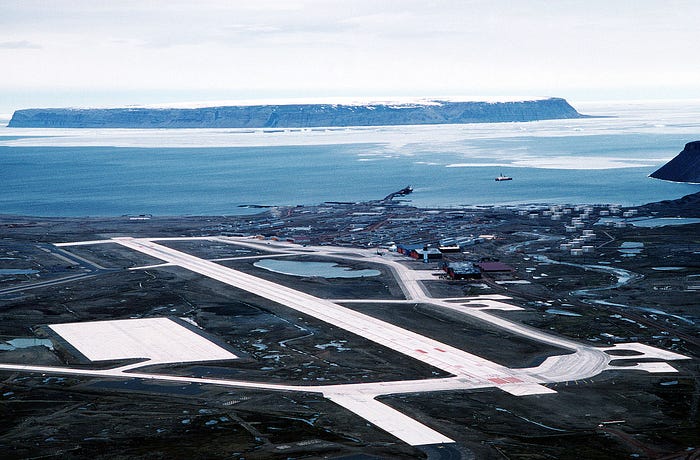
Greenland continued to have great geostrategic significance during the Cold War because it stood directly on the shortest bomber route between the United States and the urban zones of the Soviet Union. The United States ultimately made a deal with Denmark to acquire permanent rights to maintain military bases on Greenland, in the process forcing entire Inuit communities to relocate.³¹
The United States was not the only country to bring Denmark's sovereignty over Greenland into question. The United Kingdom sought during the Second World War to prevent Denmark selling Greenland to a third party without its prior consent, and some politicians in both Norway and Iceland have claimed that Greenland rightfully belongs to them.³²
When Trump suggested buying Greenland in 2019, then, he was simply adding another chapter to a long-standing international debate over sovereignty. His reasons for doing so were also very familiar.
As the Arctic ice melts, major international players like Russia and China have been scrambling to secure their interests in the region; oil rigs, busy shipping lanes, and military installations are the new reality in the once-ignored Arctic.³³
The Government of Greenland has also sought to involve the European Union in the 'Arctic bonanza,' using it as a platform to promote its own claims to sovereignty and international importance. The United States is seeking to keep pace with these developments.
Climate change and scientific advances could also bring into play 'geoengineering,' which, polar scientist Marco Tedesco explains, involves 'the ability to alter or create meteorological events (even transforming the climate) by releasing substances into the atmosphere to deliberately trigger or reduce the formation of clouds and, in turn, preserve or melt ice.'³⁴
In the 'ice-cold war,' the interests of a few tens of thousands of Greenlanders will figure little in anyone's considerations. Control of the land and its vanishing ice is more important.
This is why, despite there being sound geostrategic logic behind it, Trump's proposal is contrary to every conceivable principle of self-determination and climate justice.
Despite the US providing $12m in aid to Greenland following the rejection of Trump's offer,³⁵ the interests of a military superpower will never truly align with those of a small, semi-independent island community with a history of colonial exploitation. Financial aid is a barbed olive branch.
Should Greenland ever become independent, as most political parties in the country advocate, America's interest will become even more morally problematic. Corroding a tiny state's independence or holding it for ransom in order to gain access to its natural resources is certainly not out of the question in America's notoriously covetous foreign policy.
On a broader level, Trump's 'Greenland thing' is a powerful reminder that climate change has the capacity to turn the world as we know it upside down. Regions that were once sparsely populated and undesirable will soon become hot property in more ways than one.
As these regions drift into the sights of world leaders seeking new ways to project national power, the livelihoods of their current inhabitants will be increasingly under threat.
Notes
- Vivian Salama et al in the Wall Street Journal, 'President Trump Eyes a New Real-Estate Purchase: Greenland,' 16 August 2019. [https://www.wsj.com/articles/trump-eyes-a-new-real-estate-purchase-greenland-11565904223].
- Sky News website, 'Donald Trump confirms interest in buying Greenland in "large real estate deal,"' 19 August 2019. [https://news.sky.com/story/donald-trump-reveals-interest-in-buying-greenland-in-large-real-estate-deal-11788813].
- Lauren Gambino in The Guardian, 'Trump tweets image of enormous Trump Tower on Greenland,' 20 August 2019. [https://www.theguardian.com/world/2019/aug/19/trump-greenland-tower].
- David Crantz, The History of Greenland, Including an Account of the Mission Carried on by the United Brethren in that Country, (London: Longman Hurst, Rees, Orme, and Brown, 1820), p. 170.
- 'Eirik the Red's Saga,' translated by Keneva Kunz in The Sagas of the Icelanders, (London: Penguin Books, 2000), p. 655.
- David Abulafia, The Boundless Sea: A Human History of the Oceans, (London: Allen Lane, 2019), p. 397.
- Arnved Nedkvitne, Norse Greenland: Viking Peasants in the Arctic, (London: Routledge, 2019), p. 35.
- Ibid, p. 364.
- Hilde Norrgrén, 'An Alchemist in Greenland: Hans Egede (1686–1758) and Alchemical Practice in the Colony of Hope,' Ambix, 67 (2020), pp. 153–73.
- Erik Beukel, Frede P. Jensen, and Jens Elo Rytter, Phasing out the Colonial Status of Greenland, 1945–54, (Copenhagen: Museum of Tusculanum Press, 2010), p. 16.
- Nedkvitne, pp. 338–9.
- Ulrik Pram Gad, National Identity Politics and Postcolonial Sovereignty Games: Greenland, Denmark, and the European Union, (Copenhagen: University of Tusculanum Press, 2017), pp. 36–44.
- Beukel et al, Phasing out the Colonial Status of Greenland, p. 15.
- Marco Tedesco, Ice: Tales from a Disappearing World, (London: Headline, 2020), pp. 132–4.
- Dan McDougall in The Guardian, '"Ecological grief": Greenland residents traumatised by climate emergency,' 12 August 2019. [https://www.theguardian.com/world/2019/aug/12/greenland-residents-traumatised-by-climate-emergency].
- Eve Garnett, To Greenland's Icy Mountains: The Story of Hans Egede, Explorer, Coloniser, Missionary, (London: Heinemann, 1968), p. 185.
- Gustav Nieritz, Hans Egede: Missionary to Greenland, (Philadelphia: Lutheran Board of Education, 1876), pp. 64–72.
- Garnett, Greenland's Icy Mountains, p. 128.
- Crantz, History of Greenland, p. 152.
- Ibid, pp. 279–80.
- Nieritz, Hans Egede, p. 164.
- Garnett, Greenland's Icy Mountains, p. 166.
- Nedkvitne, Norse Greenland, p. 274.
- Ibid, pp. 266–7.
- Joshua Foer, 'Blok P, Nuuk, Greenland.' [https://www.atlasobscura.com/places/blok-p].
- Nordatlantens Brygge, 'Blok P: The final tribute.' [https://www.nordatlantens.dk/en/exhibitions/blok-p-in-nuuk/].
- Rosiland Kerven, Native American Myths, Collected 1936–1919, (Morpeth: Talking Stone, 2018), p. 439.
- Brainerd Dyer, 'Robert J. Walker on Acquiring Greenland and Iceland,' Journal of American History, 27 (1940), pp.263–6.
- Universal Studios propaganda video, 'Yanks Clear Greenland of Nazis,' 27 December 1944. [https://commons.wikimedia.org/wiki/File:1944-12-27_Yanks_Clear_Greenland_of_Nazis.ogv].
- Thorsten Borring Olesen, 'Buying Greenland? Trump, Truman and the "Pearl of the Mediterranean,"' 10 September 2019. [https://nordics.info/show/artikel/buying-greenland-trump-truman-and-the-pearl-of-the-mediterranean/].
- Beukel et al, Phasing out the Colonial Status of Greenland, pp. 51–61.
- Ibid, pp. 19 and 443–54.
- Peter Wadhams, A Farewell to Ice: A Report from the Arctic, (London: Penguin, 2017), p. 2. ; James Kraska, 'The New Arctic Geography and U.S. Strategy' in Kraska [ed.], Arctic Security in an Age of Climate Change, (Cambridge: Cambridge University Press, 2011), pp. 244–66.
- Tedesco, Ice, p. 136.
- Conor Finnegan on ABC News website, 'After Trump tried to buy Greenland, US gives island $12M for economic development,' 23 April 2020. [https://abcnews.go.com/Politics/trump-buy-greenland-us-island-12m-economic-development/story?id=70305163].