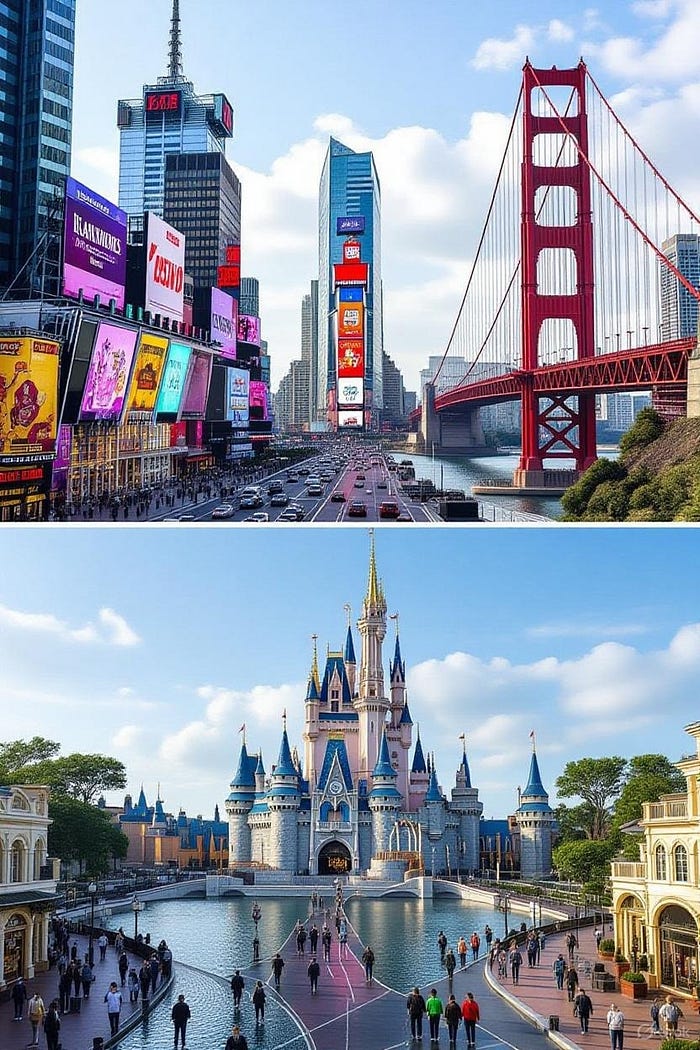


I have followed economic patterns for decades, but what is currently happening with US tourism figures is truly alarming. While the country is preoccupied with inflation and job markets, a huge economic crisis is quietly under way that few people are talking about: A near-collapse in the number of foreign visitors coming to the United States.
Allow me to tell you what I've learned, and I assure you, the numbers are even bleaker than you probably realize.
The Shocking Reality of Visitor Numbers
When I took a look at the most recent tourism stats however, I had to verify the numbers twice over. But here's the reality: America is facing a tourism emergency resulting costing the economy billions of dollars.
In 2015, the US hosted 38.4 million international visitors. By 2019 the last normal year before covid appeared that total had climbed consistently to 40.4 million. I have vivid memories of those years, when everywhere you looked you'd hear people speaking different languages, see groups of tourists and feel the effervescence that international tourists bring to our cities.
And then came 2020, and we know what happened. Visitor numbers plummeted to a mere 7.6 million as the world closed up shop. Since then, we've worked our way back up only slowly 31.5 million in 2023 followed by 35.2 million in 2024. Progress, right?
Here's where it gets concerning. The first six months of 2025 saw 15.9 million visitors versus 16.1 million in the same period a year earlier. That's a 1.2% decline. By July, it widened to 1.6%. We're going the wrong way when we should be rebounding.
Which Countries Are Staying Away?
The breakdown by region tells an even more troubling story. I've created a mental map of where our visitors traditionally come from, and almost every major region is showing declines:
- Western Europe: Down 2.3% (and these are typically high-spending tourists)
- Asia: Down 2.6% (including major markets like China and Japan)
- Caribbean: Down 3.2% (our closest neighbors)
- Oceania: Down 3.3% (Australia and surrounding areas)
- Africa: Down a massive 6% (the steepest decline)
The only areas to show slight increases are Eastern Europe (3.2%), Central America (3.1%), South America (0.7%) and the Middle East (0.2%). But these gains are minuscule next to the losses from big tourist markets.
The Countries That Worry Me Most
The trends are even more disconcerting when we focus on individual countries:
Mexico took a 7.2% hit in the first quarter, but this crept back by mid-year. India, one of our fastest-growing markets, cratered 8% during the first half of 2025 and further declined by 5.5% in July alone.
But what really caught my eye was Canada our nearest neighbour, and historically our biggest source of visitors. Canadians visiting through land dropped 25 percent, even air travel from Canada was off 10 percent. You know things are really bad when even your next-door neighbour stops coming by.
European markets are taking a beating, too: Germany down 28 percent, Spain down 25 percent, and the United Kingdom down 18 percent. These are rich countries whose people have long loved American vacations.
The States Feeling the Pain
Its impact is not evenly distributed in America. It's the border states and those with large international airports that are bearing the brunt. Seattle takes the crown for pain with a 26.9% decline in visitors that's over one-in-four out-of-townies just skipping it.
Other highly affected cities include Portland, Detroit, Louisville, Cleveland, Buffalo and Minneapolis. These aren't little towns; these are real cities with airports, hotels, restaurants and thousands of jobs tied to tourism.
I've visited many of these cities, and you can sense the contrast. Hotel occupancy is down, restaurants that were brimming with international tourists are subdued, and local tour operators are staring at half-empty buses.
The New Visa Costs That Are Scaring People Away
This is where policy choices are doing direct damage to the economy. Visitors from non-ESTA countries (ie, most of the world) will be hit with a $250 "visa integrity fee" from 1 October 2025.
Think about what this means. Countries with billions of potential tourists — like India and China now have collective visa fees of about $442 per person. For a family of four, that's $1,760 just for the privilege of being allowed to apply to visit America before they've spent a dime on flights, hotels, their own travel and other sightseeing.
Even the ESTA countries (the lucky ones, including most of Western Europe) will see their fees rise from $21 to $40. It's not big money to most Europeans, but it's a psychological hurdle and there is a message there.
In my view, this is economic self-harm. We're installing a "Not Welcome" sign at our border and charging people for the privilege of reading it.
The Economic Impact Will Shock You
And let me unpack what this tourism drop means more specifically for America, because the numbers are insane.
Every foreign visitor leaves behind an average of $4,200 while traveling. That's not just hotels it's also restaurants, shopping, transport, entertainment, theme parks, tours, and any number of other businesses that get a piece of the tourism pie.
With 560,000 fewer foreign visitors in the first seven months of 2025, we're faced with losing $2.35 billion in spending. But that's just one effect.
Here's what most people fail to grasp: tourism has an enormous multiplier effect. For each $15,000 spent in visitor spending, one job for an American is supported. That means the current downturn puts 22,000 jobs at risk immediate.
But wait, it gets worse. Oxford Economics projects that by the end of 2025, we could see an 8.2% drop in international arrivals compared to 2024. If they're right, we're looking at:
- 2.9 million fewer visitors
- $12.1 billion in lost visitor spending
- 115,000 jobs at risk
- $1.6 billion in lost tax revenue
While everyone's been focused on tourism, there's an equally serious crisis brewing in higher education. I need to tell you about what happened at Harvard because it's a perfect example of how policy changes are backfiring economically.
The University Crisis You Haven't Heard About
Even as everyone's attention is turned to tourism, an equally lethal crisis is brewing in higher education. I have to share with you what went down at Harvard, because it's a great case study of what happens when policy changes economically backfire.
US authorities in spring 2025 requested that Harvard turn over detailed data for all foreign students their nationality, visa type, research field, funding source, and even their social media accounts and political affiliations. Harvard declined, saying that the request was "overboard, intrusive and illegal."
On May 22, the government withdrew Harvard's certification to host international students. Just think about that they tried to force Harvard to close its doors to all international students.
Why International Students Matter More Than You Think
Here's something that might surprise you: international students are essentially subsidizing American education. Let me show you some real numbers from major universities:
University of Michigan:
- In-state students: $27,900 per year
- International students: $55,100 per year
UCLA:
- In-state students: $43,100 per year
- International students: $80,700 per year
International students pay almost twice what local students pay and, unlike their American counterparts, receive no financial aid, scholarships or discounts. They're paying full fledged sticker.
And then it's not like this money disappears it's what helps make American universities affordable for American students. When foreigners pay double, it enables universities to charge locals less than the true cost of education.
The Numbers That Should Terrify University Towns
International student enrolment reached a peak of 1.13 million students in 2024, a 7% jump from the previous year. India sent 331,600 students (up 23%) and China 277,400.
In 2024, these students added more than $40 billion to the US economy. It's not just that they're paying tuition; they're renting apartments, buying food, purchasing textbooks, going to the movies, and supporting thousands of local businesses in college towns across America.
But 2025 tells a different story:
- 11% fall in student enrollment projected
- 22% drop in visa issuances
- 30–40% decline in new international students possible
- 15% overall drop in international student numbers
The potential economic impact? $7 billion in lost revenue and 60,000 jobs at risk across US universities.
My Personal Take on This Crisis
I've been around: I know to what extent tourism can change economies. What's happening today is not simply a matter of numbers on a spreadsheet it's about America's wilfully choosing to be second-best, to take the world's №2 economy's place.
And I have seen small businesses in tourist-heavy locations suffer. I have spoken to hotel managers seeing lighter attendance. I've met restaurant owners who depended on foreign business and are now cutting back on employees' hours.
But here's the part that really troubles me: This is 100 percent self-inflicted. We are not losing tourists because America has become less appealing, less safe or less interesting. We are losing them because we've made it more expensive, more difficult to visit.
The visa fee rises say one thing: "Actually, we don't really want you here, but if you really must come, you can pay for the privilege.". That is not the America I want to project to the world.
The Ripple Effects You're Not Seeing

The impacts go far beyond hotels and restaurants. Think about:
Taxi and rideshare drivers who relied on airport runs and tourist trips Retail workers in places that were important to foreign shoppers Tour guides and cultural attractions that booked fewer gigs Small souvenir operations that catered to international visitors Transportation companies that ran shuttle services Entertainment venues from Broadway shows to theme parks
Every visitor lost means real people losing real money. And the impact is compounded in smaller tourist-dependent communities, where tourism may be one of the few economic engines that keep the town alive.
What This Means for American Students
Here's an irony that people may overlook: The crackdown on international students will probably make colleges more expensive for American students, too.
When universities lose high-paying foreign students, they have two options: Charge everyone else more money or reduce services and fire staff. And neither does anything to help American families who are already burdened with college costs.
I predict we'll see:
- Higher tuition for American students as universities try to replace lost international student revenue
- Larger class sizes and fewer professors as universities cut costs
- Reduced campus services and facility maintenance deferrals
- Less diverse learning environments that prepare American students for a global economy
And the students who remain in America are not going to receive as good an education as if they had been in the company of peers from around the world. That is a long-term competitive disadvantage for American graduates.
The Global Competition We're Losing
As America is erecting barriers to people who want to visit, other countries are extending the welcome mat. Canada, the U.K and Australia are aggressively recruiting on both the tourism and student end of travellers who might otherwise pick America.
I've watched the marketing campaigns other nations are undertaking, highlighting their embrace of international visitors and students. America's message, meanwhile, appears to be: "Stay home, unless you really, really need to come here."
This is not only the loss of the tourists and students this year. It is a matter of reputation and long-term relationships. A student who chooses Toronto over Boston may remain in Canada for their career. If a French family opts to vacation in London rather than New York, they might never even see America.
Looking Ahead: Can We Turn This Around?
The trends I see are troubling, but they aren't irreversible. Other nations also have suffered tourism crises, and bounced back. The issue is whether America seeks to compete for international visitors and students, or whether we are willing to become more of a backwater economy, one focusing increasingly on servicing the needs of domestic residents.
Economically, the current course is not sustainable. We are choosing to forfeit billions of dollars in economic activity and hundreds of thousands of jobs. For what? The extra visa fees will bring in some revenue, but a pittance compared to what we're losing in tourism and education expenditures.
My Recommendations for Policymakers
If I were advising policymakers, I'd suggest:
1. Re-evaluate those jump in visa fees — the economic cost doesn't justify the security gain
2. Simplify the visa application rather than complicate it
3. Launch a "Welcome to America" initiative to combat negative perceptions
4. Settle the foreign student dispute fast — every day we have is money out the door and students choosing another Institution
5. Prioritize security measures that don't penalize controversial but legitimate visitors
The current approach feels like using a sledgehammer when a scalpel would work better.
What This Means for You
Even if you yourself are not in tourism or education directly:
· So less of a tax base means either higher taxes or less services for everyone.
· Slower tourism in many countries is spilling into the overall economy
· Hospitality and education job losses ripple through service sector
· Less cultural exchange means America is less connected to global markets and tastes
I do think that America gains an enormous amount from being open to the world. The way we are going is opposite to that openness, and we're all going to be poorer for it in the true sense of the term and the other way.
The Bottom Line
America has long been enriched by, and has enriched, its welcome of the world. Our friends left too, and our tourism industry, our universities and our economy all flourished, because people everywhere wanted to experience what we had to offer.
What I'm seeing now is America self-quit that tradition. We are making it more difficult, more expensive and more uncertain for people to visit here or study here. The economic impacts are already appearing in the data, and they're going to get worse.
The choice we face could hardly be clearer: Do we want to be a country that embraces the rest of the world, and benefits from it, or a country that becomes ever more isolated and bears the economic costs that flow from it?
I know which path I hope we take. When America has opened its arms to the world, as was the case at the beginning of the last century and the end of this one, one could argue it was America at its best, and the world has flourished. The question is whether our policy makers recognize what is at stake before it is too late to change course.
The numbers speak for themselves: America's tourism and education industries are in crisis, and we have no one to blame but ourselves. We can still reverse course, but our road back will get longer and bumpier the longer we wait.
References and Sources
This article was researched and compiled using data and insights from the following source:
Primary Source:
- Economic Analysis Video: "US Economy Crisis: Overseas Visitor Numbers Falling Rapidly"
Additional Data Points Referenced:
- US Department of Commerce — National Travel and Tourism Office visitor arrival statistics
- Oxford Economics tourism forecasting reports
- US State Department visa processing data and fee schedules
- Harvard University international student enrollment figures
- University of Michigan and UCLA tuition cost comparisons
- US Bureau of Economic Analysis tourism impact multiplier calculations
Note on Data Accuracy: Any statistics, estimates or economic impacts cited in this article are based on the analysis featured in the linked YouTube video and represent the numbers available for 2025. Tourism and visa policies of countries change often and you should consult official government sources for current and official information on the countries you are visiting.
Disclaimer: All the opinions and conclusions in this article are my own speculation according to the resource. With our best efforts to denote actual data series and trends throughout, economic forecasts and policy effects may differ from reality.