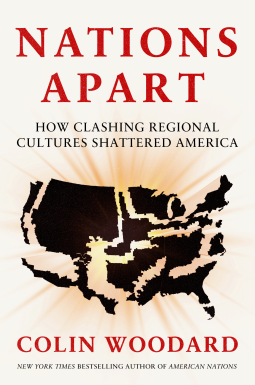


The first shocking thing about Nations Apart, by Colin Woodard is that all the stereotypes Americans use for themselves are accurate. And unchanging. The characterizations (or assassinations) of the Deep South are accurate, and so are the New England Yankee ones, the Far West, the New France of Louisiana and El Norte of Mexican border areas. All true. That's the premise, and it was unsettling to have to accept that as the basis for any kind of scientific analysis, because they are just mean clichés. Or are they?
At first, thoughtful readers will rightly reject the stereotypes as a terrible basis for analysis of the Trump era, because it is basically just name-calling. But Woodard doubles down. Not only are those stereotypes accurate, but they have not changed in 300 years. He shows that groups of founding immigrants, from Deep Southern to Appalachian to intolerant Puritans dominating the northeast not only brought their prejudices with them from England or Scotland or Germany, but they have hung onto them, throughout their expansion into more distant areas of the country. That movement can be followed by their continued prejudices, habits, philosophies, laws and attitudes, right down to today. They continue to show up in studies, polls, and the news.
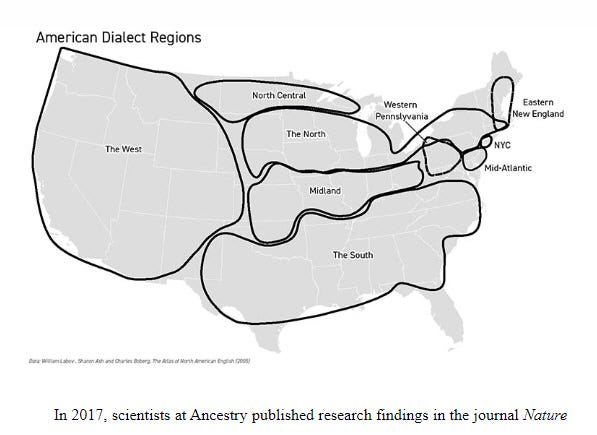
Accordingly, Woodard has broken up the USA into seven separate nations, where those 300 year-old traits continue to shape party affiliations, poll findings, election results and community positions on essentially everything. They even follow dialects and accents, confirming their existence as nations.
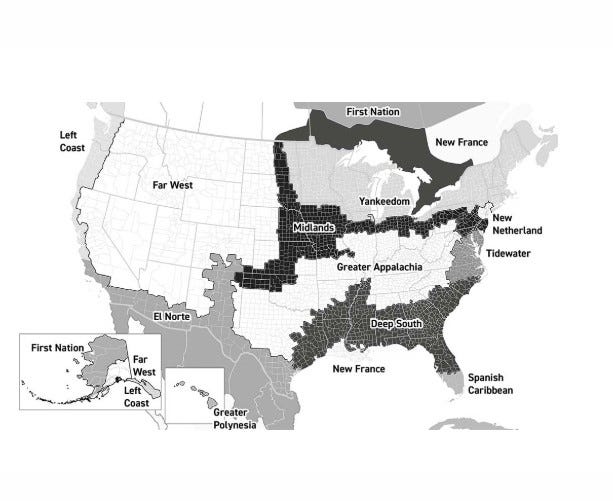
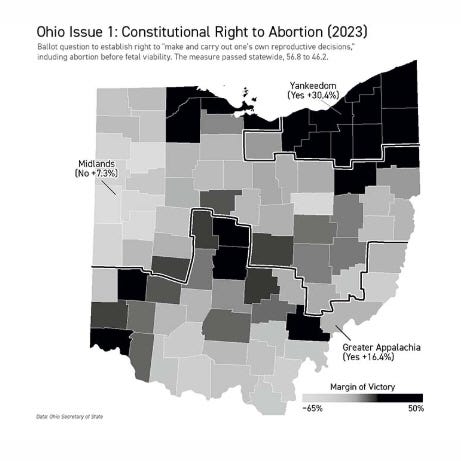
Woodard has been working at this for a long time. He founded Nationhood Lab, which studies the different traits Americans carry. The lab dissects polls and studies, accounting for the slightest weaknesses in their structure, presentation and conclusion. For accuracy's sake, they only include studies down to the county level, where the influences of various churches can be accounted for. So for example, in a meetingplace state like Ohio, the voting for or against abortion rights can be seen to border on the influence areas of several of these Nations Woodard proposes. That's how real they are. (See map below)
At numerous points, he exempts nations like Hawaiian and indigenous because their numbers are insufficient to make accurate statements. He is careful about what he says and how he says it — up to a point. But the truth is that nations like Deep South, Greater Appalachia and New France are largely ignorant, self-centered, isolated and failing.
He looks at current issues, all very front and center, like abortion, immigration, guns, climate — the usual suspects. He shows how the locals view them, and how their responses perfectly fit the stereotypes of their nations. It is sadly predictable, with never a hint that that any kind of fact-finding or reporting makes the slightest difference to anyone's automatic response. Americans' ideas and ideals are set in cement and nothing will budge them, and have not for 300 years. Only the topics change; the stereotypes predict the results.
A lot of the blame falls on religion, from Catholic to various flavors of Protestant and the evangelicals. It is those churches that determine Americans' decisions on abortion, for example. And despite 300 years of evolving science and medicine, as well as the waning influence of the Church in general, those ideas remain. "When it comes to abortion," Woodard says, "religion is destiny."
Yet farther on, he shows definitively, much as Noam Chomsky always claimed, Americans are far more progressive than their elected representatives. Americans apparently favor abortion in an absolute majority. They don't want to punish LGBTQ people, have no burning need to destroy transgender people, and so on down a long list of issues. But their elected lawmakers do. And the extreme right and evangelicals in particular, make sure they get the message right: take away all rights from those who don't fit the WASP patriarchal mold.
The business of ignoring the will of the people has come to the point where the governor of Missouri has singlehandedly repealed a number of laws that the electorate proposed and passed as voting issues in general elections. This is just one symptom of a fascist state Woodard sees forming, and very quickly. The disunity among the seven nations of the USA actually promotes the rise of fascism, he thinks.
Empathy and the common good feature prominently in the differences between these American nations. He describes Greater Appalachia and the Deep South as places where "the common good has few friends." Guns are more widely owned there, and white suicide rates by firearms lead the country.
The Deep South remains stubbornly and proudly poor and backward. Woodard says: "(T)he reason they're poor is precisely because they're aggressively individualistic, with centuries of underinvestment in their people, their institutions and infrastructure, a choice made by generations of elites so that they would have low taxes, cheap labor and uncontested political control […] If laissez-faire economics was a panacea, the Deep South would be the wealthiest region in the country and Honduras would be among the world's wealthiest nations. If high taxes and expansive services were destructive to economic performance, New Netherland, Yankeedom and the Left Coast would be the country's poorest regions and Scandinavia the world's worst. It's just not the case."
This book was completed at the top of the year, just before Trump resumed office, and Woodard makes all kinds of predictions about this regime, all of which have come true. He cites Robert Paxton's famous list of nine points for the traits of fascism, and they fit the MAGA ethos to a tee. Woodard says Trump and Trumpism tick every one of scholars' boxes defining fascism.
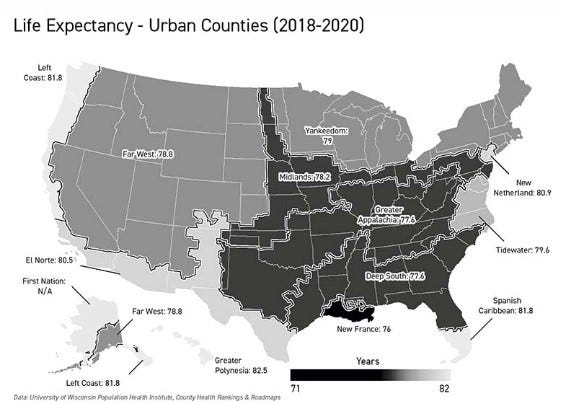
The best performances economically and socially in the USA can be seen in Yankeedom and Left Coast, where people reject individual solo efforts in favor of community and team-oriented solutions. These areas are richer, more highly educated, healthier, and longer-lived. This matches the Red-Bad, Blue-Good analysis I reviewed in 2023's State of Neglect, by far my most widely viewed review on Medium. ( https://medium.com/the-straight-dope/red-states-much-worse-than-you-think-and-they-pretend-heres-the-proof-a7aa7b12c72a ) . That book showed how far down the scale Red states are, in virtually every category from longevity to education, wealth, income and community-building. Woodard's book is a historically consistent yet significantly different way of looking at Americans across state lines, calling their geographic areas whole nations of likeminded people instead.
One unsatisfying thing about Nations Apart is that Woodard never tries to explain how it is even possible that 300 year-old prejudices remain unchanged, despite history, community, intermarriage, changes in society, laws, education and changed circumstances. How will anything ever evolve if apparently nothing can shake the 300 year old prejudices of 2025 Americans, no matter where or how they live now?
There are plenty of other questions unanswered too. Why is it that the French in Canada are so open minded and communitarian, but the French in New France (former Acadians from the Maritimes) of the southern USA are such loners? How does that work with unchanging values over 300 years? How does that jibe with where they are today? That it does not matter what you propose; Americans are locked into preset attitudes, and no amount of campaigning will see them vote against those principles.
It is precisely because he does not examine those fundamental issues that his Conclusion isn't worth anything. Woodard's Nationhood Lab posed pairs of statements to thousands of Americans, looking for ones that resonated. The idea was to find what Americans really want, and give it to them in political talking points, slogans, platform planks and so on. But if Americans are this rigid, how will any of it break through the closed minds?
His own lab studies show that essentially every new statement was rejected by Republicans and their subset of Evangelical Protestants. And even if "only" 28% of the electorate is registered as Republican, Woodard has still not found the words to appeal to them. They want their cult, their cult leader, a thrashing of the constitution, the supremacy of WASPs, the subjugation of women and will believe all the lies their cult spouts daily. What they will not stand for is that there are better ways to live and to relate to their fellow Americans.
But worst of all, this analysis means no one in the country is going to adapt or change their mind. That is damning. It's been 300 years now, so don't expect any sudden change of heart or mind. Americans will not clamor for better management by Democrats in 2028 (if there is an election at all). Talking sense to the other side is clearly pointless. Facts carry no weight. As Woodard accidently proved in his attempts to find inspiring messaging, everyone cannot relate to them; there is no common ground in the USA. None.
From the looks of it, the USA has little choice but to split into these seven separate nations, where citizen rights differ in each one. To be an American will have no meaning any more. Despite Woodard's hopeful efforts to find unifying messages, several of these nations will only be satisfied with fascism and no civil rights. Even Woodard has to admit "the single-minded pursuit of individual freedom is driving us to the brink of despotism."
Civil war will result if they all don't get everything they want right away. New England states will want to join a saner Canada, and so might Left Coast portions. No one will want The Deep South as a partner, but that's okay; The Deep South wants to go it alone anyway.
This is not the future Trump envisioned, but it is the one he is fomenting.
David Wineberg
(Nations Apart, Colin Woodard, November 2025)
.
If you liked this review, I invite you to read more in my book The Straight Dope. It's an essay collection based on my first thousand reviews and what I learned. Right now it's FREE for Prime members, otherwise — cheap! Reputed to be fascinating and a superfast read. And you already know it is well-written. https://www.amazon.com/Straight-Dope-learned-thousand-nonfiction-ebook/dp/B07Z48VQMT/